投稿者: 69578300

  • Remote Network Troubleshooting (Short-Term)

    No long-term contracts: Pay-as-you-go or per-incident.
    No direct system access: I don’t need your VPN or admin credentials.
    Collaborative support: All work is conducted via Teams, Slack, or Zoom to guide your on-site team.


    Scope

    • Identify the cause of network issues
    • Analyze configurations and traffic behavior
    • Provide clear instructions for verification and correction

    This service is limited to analysis and guidance.


    Supported Areas

    • WebFiltering
    • Firewall (FortiGate, etc.)
    • VPN (IPsec)
    • Routing / VLAN
    • Wi-Fi issues
    • Packet analysis (Wireshark)

    Communication and Access Policy

    • Configuration is performed via Teams / Slack communication
    • Commands and settings are exchanged as text (copy & paste)
    • No direct access to CLI or GUI is performed

    This avoids unintended changes and keeps all operations visible.


    Packet Analysis

    • Wireshark capture files may be requested
    • Analysis is performed offline
    • Results are explained with concrete next steps

    Pricing

    • Diagnosis Fee: €50
    • Per Incident: €100 – €250
    • Optional Success Bonus: €50 – €150

    No hourly billing.
    Pricing is based on the issue, not time spent.

    If no useful insight is provided, a partial refund may be applied.


    Availability

    • Japan Standard Time (UTC+9)
    • Response within 24 hours

    Example

    Reduced unnecessary onsite operations by redesigning network architecture (20+ devices consolidated).

    View technical case study


    Disclaimer

    • Best-effort service
    • No guarantee of full resolution
    • All changes are executed by the client

    Contact

    • Description of the issue
    • Current network structure (if available)
    • Actions already taken

    Clear information leads to faster diagnosis.

    Contact for Deployment Validation

  • Why Your Network Can Often Be Reduced to 2 or 4 Core Devices

    This page is intentionally written in English.

    This article discusses architecture, not products.

    Questions about specific implementations are welcome. This article focuses on architectural intent, but practical discussions are always encouraged.

    Executive Summary

    Conclusion first:
    In many enterprise environments, the most rational starting point is simple: connect all servers directly to a firewall platform with sufficient physical port capacity.

    Many enterprise networks have become more complex than the business itself requires.

    Over time, additional devices are introduced to solve local or short-term problems: more switches for port shortages, separate controllers for wireless, and additional security layers added incrementally. While each decision may have been reasonable in isolation, the accumulated result is often a network that is expensive to operate, difficult to explain, and structurally inefficient.

    This document proposes a different perspective.

    In many ordinary enterprise environments, the core network and security function can often be consolidated into 2 or 4 core security devices, without sacrificing resilience or future growth. This is not an argument for aggressive minimalism, but for disciplined architecture.

    The key principle is simple: network design should start from the actual server structure and real port requirements, not from predefined switch hierarchies or historical design patterns.

    A reduced core device count has direct economic implications. Every additional device consumes power continuously, generates heat, occupies rack space, and introduces operational overhead. Energy cost is no longer a stable variable; it is increasingly influenced by external factors beyond the organization’s control.

    Reducing unnecessary device count therefore becomes not only an efficiency measure, but a form of structural risk mitigation.

    Importantly, this approach does not eliminate future expansion. Access switching and wireless infrastructure can be added later in a controlled and integrated manner, without destabilizing the core architecture.

    For clarity, this document uses Fortinet-based examples. However, the architectural principles described here are vendor-neutral and applicable to any integrated network security platform capable of centralizing policy, routing, and control.

    The objective is straightforward: to build networks that are easier to explain, safer to operate, more resilient to change, and economically rational over their entire lifecycle.

    Before: When Port Count, Not Architecture, Drives the Design

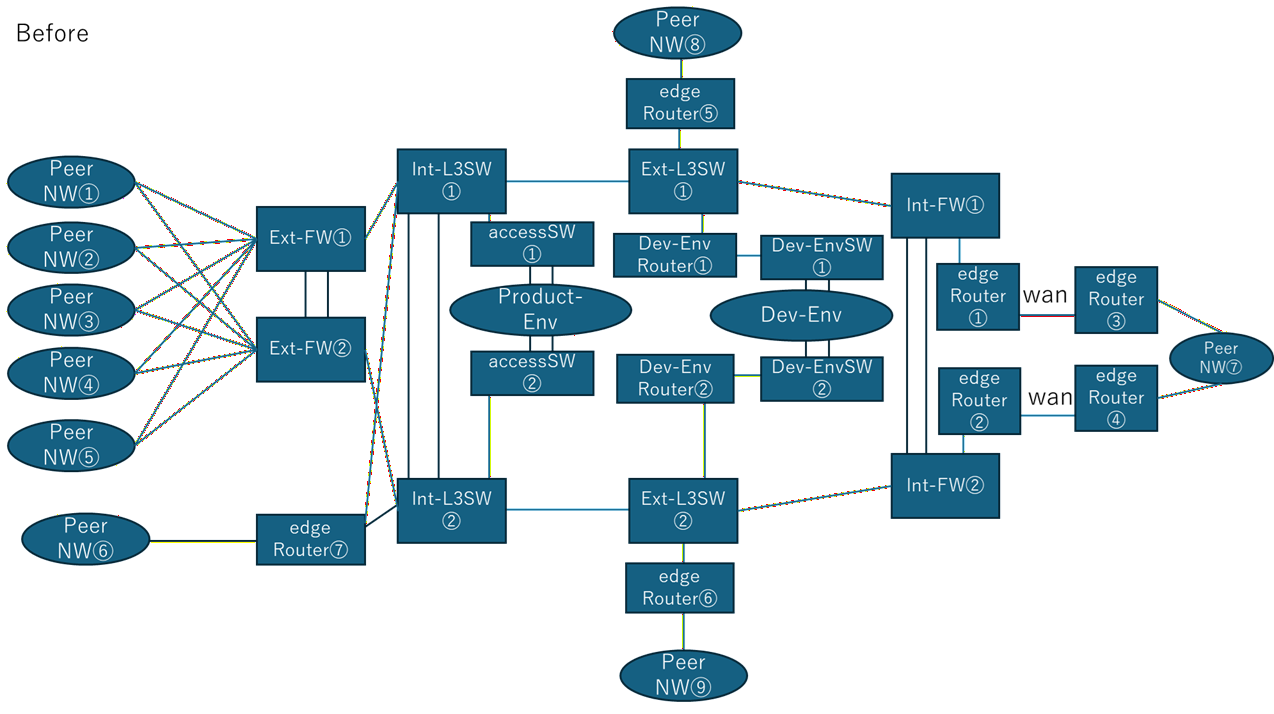
    The diagram below shows a typical enterprise network that has grown through incremental decisions rather than architectural intent.

    Firewalls, Layer-3 switches, access switches, environment-specific devices, and edge routers have been added over time to solve local problems such as port shortages, segmentation, or redundancy requirements.

    Figure (Before): An enterprise network structure that evolved through incremental additions, resulting in layered devices, fragmented responsibilities, and increased operational and energy cost.

    As a result, servers are no longer connected where policy and routing decisions are made. Instead, they are placed behind multiple layers of switching, each introducing additional power consumption, operational complexity, and failure points.

    In this structure, device count is driven not by necessity, but by historical layering. Redundancy exists, but responsibility is fragmented. The network works, but it is difficult to explain, difficult to operate safely, and expensive to maintain over time.

    The difference between these two diagrams is not technology. It is intent.

    After: When Architecture, Not Port Count, Defines the Network

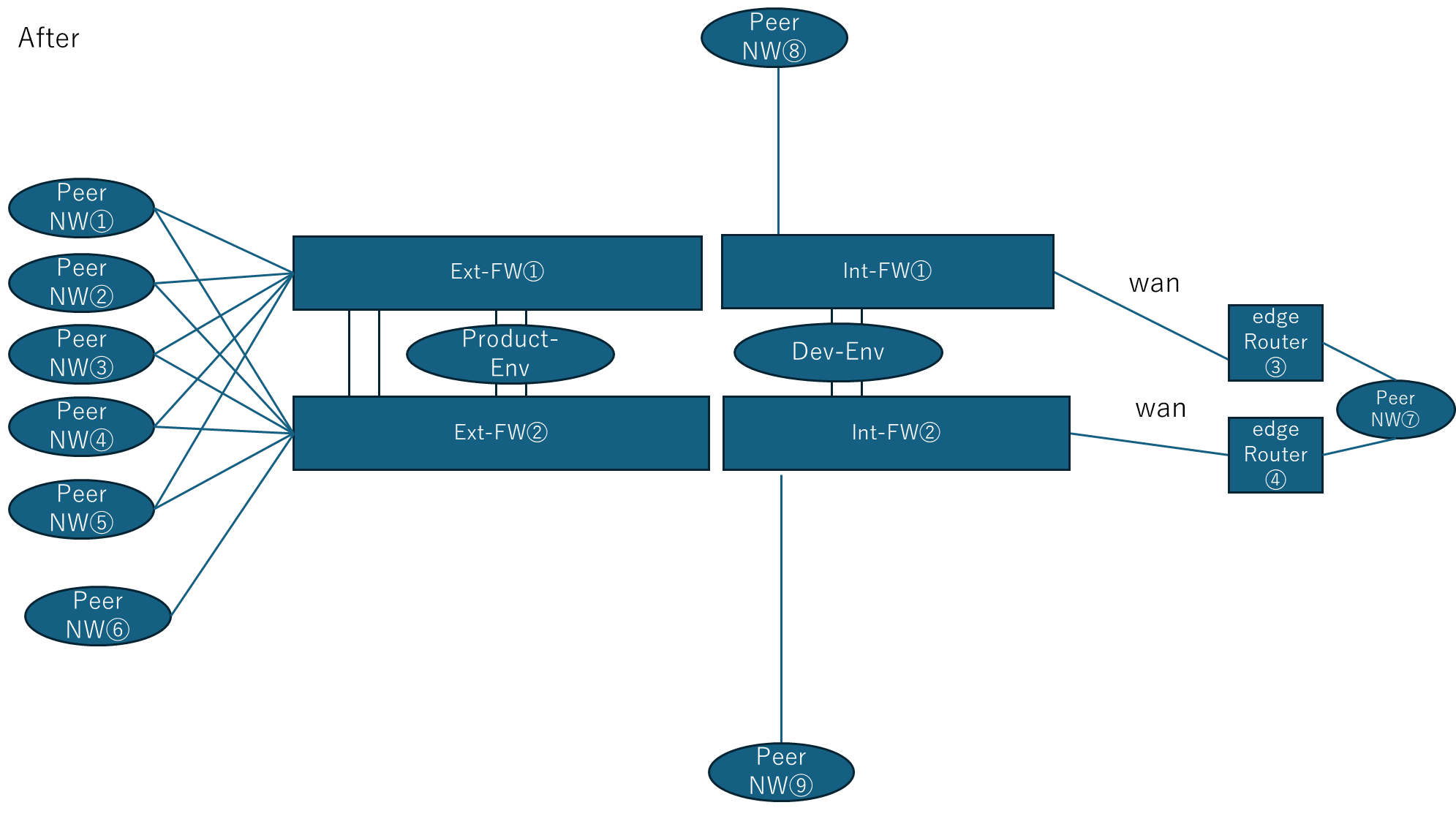
    The diagram below shows the same environment after the network has been redesigned around architectural intent rather than incremental expansion.

    The number of devices has been reduced significantly, but this reduction is not the goal. It is the result of concentrating routing, policy enforcement, and failure domains into a small number of clearly defined core security devices.

    It is also worth noting that there are platforms where additional switching capacity can be introduced in an SDN-style manner, with firewalls and switches operating under a unified control plane. In such cases, both components effectively behave as a single logical system, significantly reducing configuration effort and operational overhead.

    Similarly, some platforms integrate wireless LAN controller functionality as a native capability rather than as a separate appliance. The existence of these designs further demonstrates the generality of the network architecture proposed here.

    The intent of this approach is not to depend on a specific product feature set, but to show that concentrating control, policy, and expansion under a coherent architectural model is broadly achievable across modern network platforms.

    Figure (After): A redesigned core architecture where routing and security policy are consolidated into a small number of firewall-centric devices, reducing device count, baseline power consumption, and long-term operational constraints while preserving resilience.

    In this structure, servers are connected directly to the firewall layer. Layer-3 control and security policy are enforced at a single, well-defined point, eliminating the need for intermediate routing and switching layers that previously existed only to compensate for port limitations.

    As a result, the core architecture becomes easier to explain, easier to operate, and easier to expand. Redundancy is preserved, but responsibility is no longer fragmented across multiple device types and layers.

    Fewer always-on devices mean lower baseline power consumption and fewer long-term operating constraints.

    This is not a design that eliminates future growth. Access switching and wireless infrastructure can still be added where needed, but they are added as extensions of a stable core rather than as structural dependencies.

    The reduction from twenty devices to four is therefore not an exercise in minimization. It is a correction of architectural focus.

    Design assumptions behind this architecture:

    First, the firewall platform directly terminates external circuits. This removes the need for separate edge routing devices and ensures that routing decisions, security policy, and failure boundaries remain aligned.

    Second, multiple LAN-side default gateways are defined per segment on the firewall. This allows internal segmentation requirements to be met without introducing additional routing devices solely for gateway distribution.

    These are not the core message of this design. They are practical implementation assumptions that support the architectural objective: reducing unnecessary devices while keeping responsibility centralized and explicit.

    Conclusion

    Many networks are complex not because the business truly requires it, but because complexity has been allowed to accumulate.

    By starting from the real server structure, estimating realistic port requirements, separating server and network renewal, minimizing unnecessary Layer-2 sprawl, and treating power cost as a structural design input, networks can remain simpler, safer, and economically rational over time.

    This is why the question is not “how many devices do we have,” but “why do we need them at all.”

    This Is Not a Theory

    The approach described in this article is not hypothetical. It is based on actual network redesign and consolidation projects.

    If you are operating a network with excessive device count, this kind of structural simplification may already be possible in your environment.

    We provide architecture design and implementation support for these transformations.

    → See also: Architecture Philosophy
    → Related: 20+ to 4: HA Firewall Consolidation

    Contact for Deployment Validation

  • From 20 Devices to 4 Devices: Power Triage for Starlink in Contested Environments

    From Reduction to Survival: Power Triage in Starlink-Based Networks

    Power failure is often treated as a technical issue.

    It is not.

    In real-world conditions—especially where both grid power and terrestrial networks fail—the problem is no longer connectivity.

    The problem is:

    What survives.

    This article extends a prior design principle: reducing infrastructure from 20+ devices to 4 systems.

    Without reduction, survival cannot be designed.

    You Cannot Triage Complexity

    Power triage cannot be applied to a fragmented architecture.

    When systems are composed of dozens of independent devices:

    • Power consumption is scattered
    • Criticality is unclear
    • Shutdown sequences are undefined

    The result is predictable:

    • Everything is treated as critical
    • UPS capacity is increased blindly
    • Failure becomes chaotic

    This is not a power issue.

    This is a failure of architectural reduction.

    From 20 Devices to 4 Systems

    Reducing infrastructure is not only about cost.

    It is about making decisions possible.

    In a reduced architecture:

    • Network termination is consolidated
    • Roles are clearly defined
    • Dependencies become visible

    This enables something that was previously impossible:

    Deterministic behavior under failure.

    Before Reduction (Typical Environment)

    • Multiple routers per WAN
    • Distributed firewall functions
    • Layer 2 switching dependency
    • Unclear traffic paths

    Result:

    • No clear shutdown priority
    • No predictable survival model

    After Reduction (20 → 4)

    • Consolidated firewall-based routing
    • HA pairs with defined roles
    • Minimal Layer 2 dependency
    • Clear segmentation

    Result:

    • Priority becomes definable
    • Triage becomes executable

    UPS Is Not the Design

    UPS is often misunderstood as the solution.

    In reality:

    • UPS only extends time
    • It does not define priority
    • It does not decide what survives

    Without prior design, UPS simply prolongs confusion.

    Power Triage: Designing What Survives

    Power triage is the process of deciding:

    • What must remain powered
    • What must be safely shut down
    • What can be immediately abandoned

    This is not electrical engineering.

    This is operational architecture.

    Example: Triage in a Reduced System

    Note: The following example assumes that authentication and core control-plane services are already preserved.

    ComponentActionPurpose
    NASGraceful shutdownPrevent data loss
    Full Wi-Fi coverageDisableReduce load
    User endpointsLimit to onePreserve energy
    StarlinkMaintainPreserve communication
    LoggingMinimal but consistent and time-alignedPreserve traceability

    Authentication Must Survive Before Connectivity

    In many failure scenarios, network connectivity is not the first thing to disappear.

    Authentication is.

    This creates a critical condition:

    • The network is still operational
    • Routing is functional
    • Links are alive

    But:

    • No user can log in
    • No administrator can access systems
    • No service can be authenticated

    This is a complete operational failure.

    Connectivity without authentication is unusable.

    Implication for Power Triage

    Authentication systems must be treated as Tier 0 components:

    • Directory services (e.g., AD)
    • RADIUS / AAA systems
    • DNS (critical dependency)

    These systems must remain powered before:

    • Storage systems (NAS)
    • Full network access
    • User endpoints

    If authentication fails first, the rest of the system becomes irrelevant.

    Forensic Survivability: Logging and Time Must Survive

    Reducing power consumption does not mean abandoning observability.

    In fact, the opposite is true.

    During failure or attack scenarios, the ability to reconstruct events becomes more critical than ever.

    This requires two elements:

    • Minimal but reliable logging
    • Consistent time synchronization

    Time is not metadata.

    It is the foundation of all analysis.

    Implications for Power Triage

    • At least one trusted time source must remain available
    • Critical systems must maintain synchronized clocks
    • Logs must remain consistent across devices

    If time collapses, investigation collapses.

    Starlink Under Power Constraints

    Starlink is not a low-power system.

    • Continuous power is required
    • Reboot time is non-trivial
    • Link stability depends on power continuity

    Therefore, Starlink must be integrated into a triage model, not blindly protected.

    Two Operational Modes

    Normal Mode

    • Full Starlink operation
    • All network services active

    Triage Mode

    • Reduced network footprint
    • Minimal communication channel
    • Controlled power allocation

    When Communication Is Impossible

    In severe conditions:

    • LTE may be unavailable
    • External networks may be unreachable

    This must be assumed.

    Therefore, the goal is not immediate reporting.

    The goal is to be ready to communicate when the window opens.

    Eliminating Dependency on Chance

    If your system depends on:

    • Employee-owned batteries
    • Personal devices
    • Ad-hoc decisions

    Then it is not a system.

    It is coincidence.

    A designed system requires:

    • Defined power allocation
    • Defined shutdown sequence
    • Defined communication protocol

    Conclusion

    Power failure does not test your hardware.

    It tests your architecture.

    You are not designing uptime.
    You are designing what survives when uptime is impossible.

    Read our Network Architecture Philosophy:
    https://g-i-t.jp/philosophy/

    Contact for Deployment Validation

  • Reducing the number of customer-edge WAN routers by terminating multiple WAN circuits on a single FortiGate.

    Executive Summary

    In this design, multiple WAN circuits are terminated directly on a single FortiGate, eliminating the need for separate customer-edge WAN routers.

    This is not a cost optimization, but a structural redesign of the network edge.

    Why This Article Exists

    Many network designs still assume that WAN circuits should first terminate on dedicated edge routers, and only then be handed over to a firewall. In this validation, that assumption was intentionally removed.

    The FortiGate was used not only as a security device, but also as the routing termination point for multiple WAN circuits.

    The Traditional Approach

    A common enterprise edge design looks like this:

    • WAN circuit
    • Customer-edge router
    • Firewall
    • Internal network

    This separation may look clean on paper, but it also increases device count, operational overhead, and failure points.

    The Design Shift

    In this design, multiple WAN circuits are terminated directly on a single FortiGate.

    • No dedicated customer-edge WAN router is placed in front of the firewall
    • The firewall handles both security enforcement and WAN-side routing termination
    • The edge becomes simpler and easier to understand

    This is not about collapsing roles recklessly. It is about removing an unnecessary device boundary where the firewall is already capable of handling the required function.

    Basic Topology

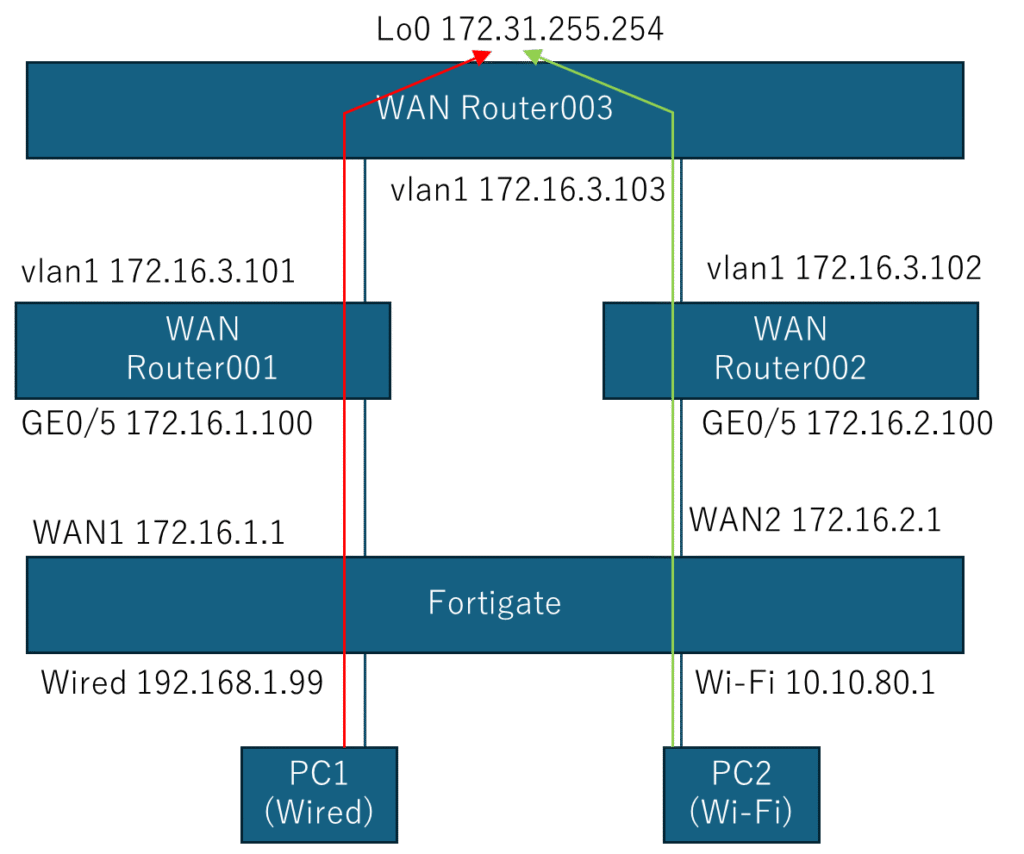
    The following topology was used in this validation.

    This structure defines how traffic is separated before any routing decision is made.

    Each LAN-side segment was intentionally kept simple. In this case, the FortiWiFi unit provided two client-side segments: one wired and one Wi-Fi.

    Each segment was forwarded to a different upstream path through a separate WAN-facing route policy.

    Validation Results

    Both clients reached the same destination, but through different upstream paths.

    Wired Client

    IPv4 Address: 192.168.1.110
    Default Gateway: 192.168.1.99
    
    tracert 172.31.255.254
    
    1  192.168.1.99
    2  172.16.1.100
    3  172.31.255.254

    Wi-Fi Client

    IPv4 Address: 10.10.80.2
    Default Gateway: 10.10.80.1
    
    tracert 172.31.255.254
    
    1  10.10.80.1
    2  172.16.2.100
    3  172.31.255.254

    Both clients reach the same destination, but through completely different upstream paths.

    This is not load balancing. The egress path is explicitly determined by the ingress segment.

    FortiGate Configuration

    The separation in this validation was implemented with FortiGate policy routes.

    config router policy
        edit 1
            set input-device "internal"
            set gateway 172.16.1.100
            set output-device "wan1"
        next
        edit 2
            set input-device "wifi"
            set gateway 172.16.2.100
            set output-device "wan2"
        next
    end

    Traffic entering from the wired segment was forwarded to WAN1 via 172.16.1.100, while traffic entering from the Wi-Fi segment was forwarded to WAN2 via 172.16.2.100.

    This example uses a straightforward policy-route configuration rather than newer SDN-style abstractions. That choice is intentional: the goal here is clarity, reproducibility, and narrow validation scope.

    Scope Limitation

    This validation intentionally avoids additional abstraction layers.

    • No LAG
    • No VRF
    • No SVI-based segmentation in this example

    FortiGate can support SVI-based designs, but they were intentionally excluded here in order to keep the structure narrow, visible, and easier to validate.

    Why This Matters

    Reducing customer-edge WAN routers is not merely a hardware reduction exercise.

    It changes how the network edge is defined:

    • fewer devices
    • fewer failure domains
    • clearer traffic behavior
    • simpler operational visibility

    If a design only works with advanced abstractions, it is not a robust starting point. This validation shows that the edge can be simplified first, and extended later only when necessary.

    Conclusion

    This is not about removing routers for the sake of reduction.

    It is about removing the assumption that separate customer-edge WAN routers are always required.

    Contact for Deployment Validation


    Related reading:
    Read our Network Architecture Philosophy

    Related case study:
    [Insert link to your 20→4 fixed page here]

  • Transparent Firewall Validation: Obfuscating Target OS Information Against External Reconnaissance(FortiGate Validation)

    Transparent Firewall Validation: Obfuscating Target OS Information Against External Reconnaissance(FortiGate Validation)

    Transparent Firewall Validation: Obfuscating Target OS Information Against External Reconnaissance

    This technical validation is intentionally documented in English for the global engineering community and NIS2 compliance officers.


    Overview: Why “Hidden” OS Data is Your First Line of Defense

    The conclusion of this validation is clear: By inserting a Transparent Mode Firewall into an existing network, you can effectively obfuscate the Operating System (OS) information of target devices from external attackers.

    During the reconnaissance phase of a cyber attack, adversaries use tools like Nmap to identify OS versions and target specific vulnerabilities. Our real-world testing proves that a transparent-mode FortiGate acts as a “digital camouflage,” deceiving scanners and significantly reducing the accuracy of automated reconnaissance.

    The Strategic Value: Beyond Just “A Firewall”

    • OS Fingerprint Obfuscation: Forces scanners into “guess-mode,” preventing precise exploit targeting.
    • Zero Network Design Change: Achieve high-level security by simply “adding” a layer—no IP changes or routing re-designs required.
    • Evidence-Based Security: Moving beyond consultant-speak to prove protection via raw packet-level behavior.

    Technical Deep Dive: Disrupting the Nmap Fingerprinting Engine

    While AI summaries might simply state “OS not detected,” a professional analysis of the Raw Zenmap Logs reveals exactly how the FortiGate transparent engine protects the host. Below is the actual evidence from our validation lab.

    1. Evidence: Raw Nmap/Zenmap Signature Scan

    Note the “tcpwrapped” status and the “No exact OS matches” warning. This is the sound of an attacker’s reconnaissance failing in real-time.

    Starting Nmap 7.98 ( https://nmap.org ) at 2026-03-25 15:20 +0900
    Nmap scan report for 192.168.100.100
    Host is up (0.0018s latency).
    Not shown: 993 closed tcp ports (reset)
    PORT     STATE SERVICE      VERSION
    135/tcp  open  msrpc          Microsoft Windows RPC
    139/tcp  open  netbios-ssn    Microsoft Windows netbios-ssn
    445/tcp  open  microsoft-ds?
    2000/tcp open  tcpwrapped
    5060/tcp open  tcpwrapped
    5357/tcp open  http           Microsoft HTTPAPI httpd 2.0 (SSDP/UPnP)
    8008/tcp open  http
    
    Aggressive OS guesses: Microsoft Windows 11 21H2 (98%), Microsoft Windows 10 (94%)
    No exact OS matches for host (If you know what OS is running on it, see https://nmap.org/submit/ ).
    
    TCP/IP fingerprint:
    OS:SCAN(V=7.98%E=4%D=3/25%OT=135%CT=1%CU=37785%PV=Y%DS=1%DC=D%G=Y%M=FC6198%
    OS:TM=69C37F66%P=i686-pc-windows-windows)SEQ(SP=102%GCD=1%ISR=104%TI=I%TS=A
    OS:)OPS(O1=M5B4NW8ST11%O2=M5B4NW8ST11%O3=M5B4NW8NNT11%O4=M5B4NW8ST11)
    ...[Full Fingerprint Captured]...
    

    2. Analysis of the “tcpwrapped” Defense

    The appearance of “tcpwrapped” on ports 2000 and 5060 confirms that the FortiGate is intercepting the TCP three-way handshake. The firewall validates the connection but refuses to pass application-layer data to the scanner, effectively closing the door before the attacker can peek inside.

    3. Predictable Deployment (L1 Timer Consistency)

    The strategic advantage of this “surgical” insertion is its predictability. As documented in our Downtime Verification Report, the insertion downtime is strictly tied to the 10-second L1 Link-up timer. This makes it a low-risk, high-reward implementation for production environments.


    Strategic Implications for NIS2 Compliance in Finland

    For Finnish enterprises navigating NIS2 requirements, the ability to “add” robust reconnaissance protection without a multi-month network migration is a critical competitive edge. Large SIs often overlook these precision-based deployments in favor of massive infrastructure overhauls.

    Seeking a non-disruptive security audit or NIS2-compliant architecture?

    We specialize in “add-on” security that preserves business continuity while disrupting attacker reconnaissance.
    Contact for Deployment Validation


    Practical Notes

    • Testing was conducted in a controlled environment using FortiGate (Transparent Mode).
    • OS obfuscation results may vary depending on deep packet inspection (DPI) settings and target OS versions.
    • Real-world downtime was measured at 10.8 seconds, aligning with theoretical L1 recovery intervals.

    → Read our Philosophy: Why we prioritize non-disruptive design

  • Measured Downtime During Inline Insertion of a Transparent Firewall

    Measured Downtime During Inline Insertion of a Transparent Firewall

    Measured Downtime During Inline Insertion of a Transparent Firewall

    This test measures the interruption window observed during inline insertion of a transparent-mode firewall.


    Test Objective

    To evaluate the impact of physically inserting a transparent firewall into an active network path, focusing on real-world deployment conditions.


    Test Environment

    • Firewall: FortiGate (transparent mode)
    • Upstream device: Cisco CBS250-8T-D-JP (default settings)
    • Client: Windows PC
    • Topology: PC → FortiGate → Router → Internet

    The firewall was fully booted and operational before insertion.


    Test Method

    A continuous ICMP echo request was sent to a public endpoint.

    ping 8.8.8.8 -t | ForEach-Object { "{0:HH:mm:ss.fff} {1}" -f (Get-Date), $_ }
    

    During the test, the WAN-side cable of the firewall was removed and immediately reinserted, simulating a real inline deployment operation.

    The test was performed multiple times under identical conditions. The maximum observed interruption window was used for evaluation, to reflect a conservative estimate suitable for real-world deployment planning.


    Observed Result

    21:34:45.787 8.8.8.8 からの応答: バイト数 =32 時間 =3ms TTL=117
    21:34:50.571 要求がタイムアウトしました。
    21:34:55.575 要求がタイムアウトしました。
    21:34:56.585 8.8.8.8 からの応答: バイト数 =32 時間 =4ms TTL=117
    

    The last successful reply was recorded at 21:34:45.787, and successful replies resumed at 21:34:56.585.

    This indicates an observed interruption window of approximately 10.8 seconds.


    Interpretation: Alignment with Theoretical L1 Recovery

    The observed interruption window of 10.8 seconds is highly consistent with standard enterprise-grade network hardware behavior, rather than an arbitrary delay.

    Theoretical Basis: Most managed switches and firewalls utilize a 10-second L1 Keepalive/Link-up timer (often influenced by carrier delay settings) by default.

    Validation of Predictability: Our measurement of 10.8 seconds (the interval between the last successful ICMP reply and the first recovered reply) confirms that the downtime is strictly dictated by physical layer link-state detection.

    Engineering Conclusion: This result demonstrates that inserting a transparent-mode firewall does not trigger unpredictable software-level re-convergence or routing instability. The downtime is transparent, predictable, and scientifically grounded within standard L1 recovery intervals.


    Operational Considerations

    In real deployments, sufficient maintenance time must be secured in advance, as even short interruptions can impact active sessions and services.

    This measurement prioritizes worst-case behavior over average performance, to support safe deployment planning.


    Related Evidence

    View all validation results

  • Allowing VRRP, HSRP, and STP Through Transparent-Mode FortiGate

    Allowing VRRP, HSRP, and STP Through Transparent-Mode FortiGate

    Allowing VRRP, HSRP, and STP Through Transparent-Mode FortiGate

    This post records validation results for passing control traffic through a FortiGate deployed in transparent mode. The focus is on VRRP, HSRP, and STP/BPDU behavior.

    The purpose of this test is not to repeat vendor documentation, but to confirm actual behavior with real devices and real command outputs.


    Scope of Validation

    • VRRP forwarding
    • HSRP forwarding
    • STP/BPDU forwarding
    • Effect of set stpforward enable

    VRRP Verification (Cisco)

    Two Cisco routers were connected with a transparent-mode FortiGate inserted between them.

    Router#show vrrp brief
    Interface          Grp Pri Time  Own Pre State   Master addr     Group addr
    Gi0/5              1   100 3609       Y  Backup  192.168.84.2    192.168.84.254
    Router#

    The router remained in Backup state, confirming that the Master was detected.


    HSRP Verification (Cisco)

    Router#show standby brief
    Interface   Grp  Pri P State   Active          Standby         Virtual IP
    Gi0/5       1    100   Standby 192.168.84.1    local           192.168.84.254
    Router#

    The router remained in Standby state, confirming that the Active router was detected.


    VRRP Verification (NEC IX)

    Two NEC IX routers were connected with a transparent-mode FortiGate inserted between them. VRRP operated normally.


    STP/BPDU Behavior

    Layer 2 switches were tested with a transparent-mode FortiGate inserted between them.

    Topology

    • Cisco Catalyst 2960
    • Aruba 2530

    Result (via FortiGate)

    Switch#show spanning-tree | i root
    This bridge is the root
    
    HP-2530# show spanning-tree | i root
    This switch is root
    

    Both switches identified themselves as root, indicating that STP was not exchanged.


    Direct Connection Check

    When directly connected, STP operated normally.

    This confirms that FortiGate blocked BPDU in the default configuration.


    Configuration Change

    config system interface
    edit <interface-name>
    set stpforward enable
    next
    end

    After enabling this setting, STP communication became functional.


    Conclusion

    • VRRP passes through transparent FortiGate
    • HSRP passes through transparent FortiGate
    • STP is blocked by default
    • stpforward is required for BPDU forwarding

    If BPDU forwarding is not enabled, multiple root bridges may form, leading to unstable Layer 2 topology.


    This case is part of our Validation Evidence.

    View Validation Evidence

  • From the Development Lab

    From the Development Lab

    Consolidating 20+ Devices into 4 Firewalls

    In many legacy enterprise environments, network topology evolves without being redesigned. Devices are added over time, but rarely removed. The result is an architecture with over twenty devices performing overlapping or redundant roles.

    In one recent case, we proposed a radical simplification: consolidating more than twenty devices into just four firewalls.

    The target architecture consisted of:

    • External Firewall (Primary)
    • External Firewall (Secondary)
    • Internal Firewall (Primary)
    • Internal Firewall (Secondary)

    This was not merely a hardware reduction. It was a redesign of responsibility, routing, segmentation, and operational logic.


    Direct WAN Termination on Firewalls

    The original environment included multiple routers terminating various WAN circuits. Instead of maintaining separate routing devices, we made a deliberate decision:

    • Terminate WAN circuits directly on the firewall
    • Eliminate standalone routers entirely

    Modern firewalls are fully capable of handling WAN termination, dynamic routing, policy routing, and redundancy. Keeping routers “because that’s how it has always been done” adds cost without increasing resilience.

    By collapsing routing and security into the firewall layer, we reduced devices and simplified failover design.


    Segment-Specific Default Routes

    Instead of using a single upstream path for all traffic, we implemented:

    • Separate default routes per LAN segment

    Each segment was intentionally given its own outbound path policy. This approach improved traffic control, enabled cleaner security zoning, and removed the need for complex L2 workarounds.

    Design replaces bandwidth as the primary performance tool.


    Eliminating All L2 Switches via Firewall VLAN Control

    Modern firewalls allow direct VLAN configuration and segmentation control. Therefore:

    • All downstream Layer 2 switches became unnecessary

    Rather than ignoring available firewall interfaces, we used them deliberately. When a firewall provides switch-like port density and VLAN control, placing a Layer 2 switch beneath it “by default” wastes both capital and architectural clarity.

    Reducing switching layers:

    • Decreases failure points
    • Reduces broadcast domain ambiguity
    • Simplifies troubleshooting
    • Improves total asset efficiency

    Port cost matters. Unused firewall interfaces represent hidden capital waste.


    Security Expansion via License Modification

    The consolidation strategy also improved future security posture. Instead of purchasing new appliances:

    • IPS and WAF capabilities can be activated through license changes

    Security evolution becomes a software decision, not a hardware replacement project. This dramatically improves capital efficiency and deployment speed.


    Built-in WLC for Future Wireless Expansion

    The firewall platform includes a Wireless LAN Controller function enabled by default. This provides:

    • Immediate readiness for future wireless AP deployment
    • Unified security and wireless policy control
    • Improved cost-performance ratio during expansion

    When wireless infrastructure is introduced later, no separate controller appliance is required. The architecture scales without structural redesign.


    Design Is the Investment

    The consolidation from over twenty devices to four was not a budget cut. It was a design correction.

    Overinvestment in hardware often masks underinvestment in architecture. True efficiency does not come from adding devices, but from redefining their roles.

    Twenty-plus devices were reduced to four.
    Routers were removed entirely.
    Switch layers were eliminated.
    Security features became license-driven rather than hardware-driven.

    This is not minimalism. It is structural clarity.

    Decrypting files encrypted by ransomware

    Specific methods (Japanese)

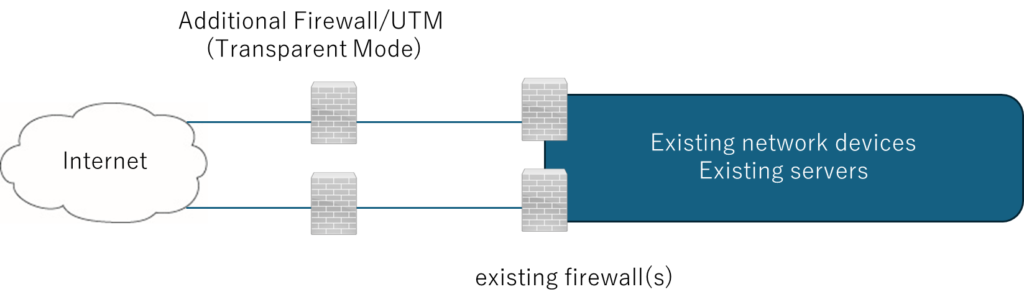
    Add a Firewall/UTM from a Different Vendor

    By adopting a firewall/UTM from a different vendor than the existing one, a layered defense strategy is achieved.

    Theoretical Maximum Downtime: 10 Seconds

    The “within 10 seconds” requirement is based on the Layer-1 keepalive timer.

    Transparent Mode:
    A device that operates like a Layer-2 switch while functioning as a firewall/UTM.

    The discovery timing of newly identified vulnerabilities will be the same for manufacturers that adopt open algorithms.

    At the link below, we introduce firewall/UTM vendors whose products are more closed in design. (Please note that the content may remain in Japanese.)
    Internal link

    Compromised Home Routers Used as Attack Proxies

    Home Routers as Attack Proxies

    Compromised Consumer Routers for External Attack Proxying

    Consumer Router Botnets Used for External Attacks

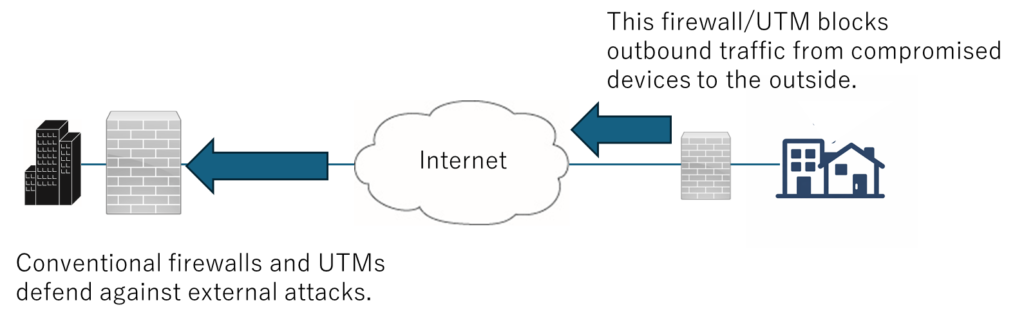
    The FW/UTM on the right side of the diagram blocks outbound traffic from compromised devices from reaching external networks.

    The above firewall/UTM is assumed to operate in transparent mode (functioning as an L2 switch while providing firewall/UTM-equivalent protection).

    A Tool That Further Supports Our GenAI-Driven DX Enablement Service

    Remove micro-friction from development so leadership can keep the tempo.

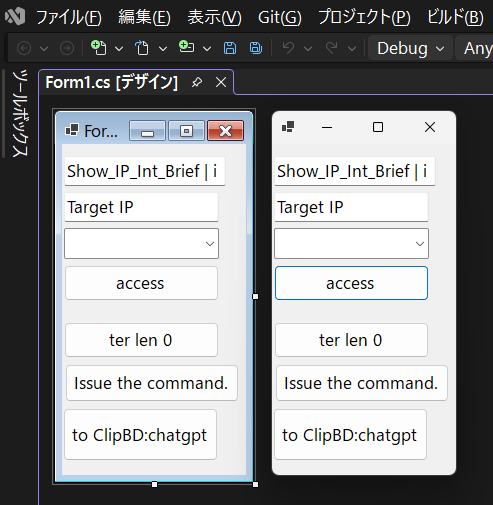
    Visual Studio automation as RPA

    When you’re not sure where to click in a GUI like Visual Studio, GenAI uses Python-based automation to move the mouse and click for you.
    This eliminates “cursor confusion” during screen sharing sessions, allowing you to maintain the pace of implementation, decision-making, and validation.
    This idea is free.


    Visual Studio automation as RPA

    Log4_CIO

    Deterrence created when a CIO uses on-site operational terminology.

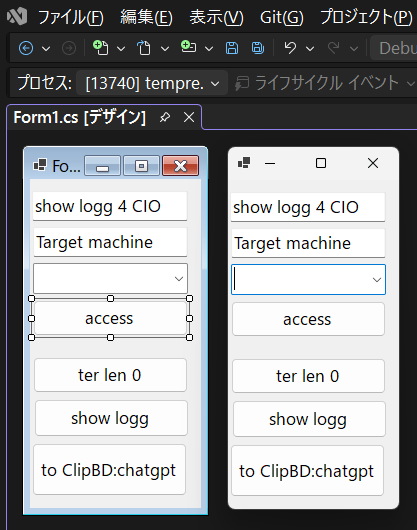
    Confirm you are logged into the intended target.

    Deterrence created when a CIO uses on-site operational terminology.

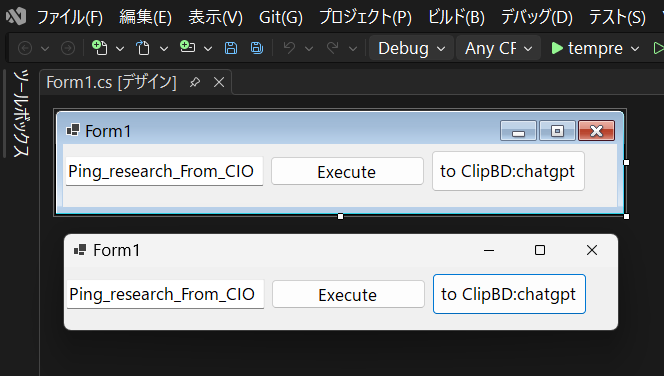
    Ping_research_From_CIO

    Deterrence created when a CIO uses on-site operational terminology.

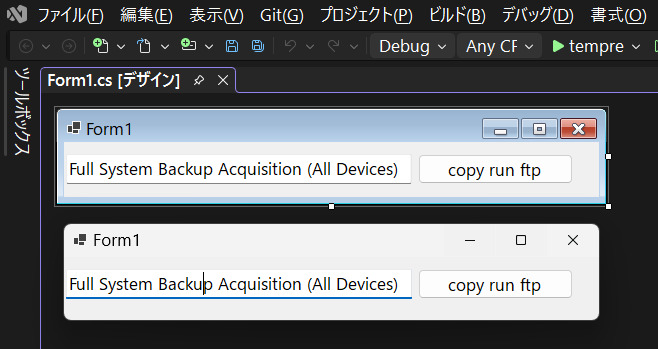
    Full System Backup Acquisition (All Devices)

    Deterrence created when a CIO uses on-site operational terminology.

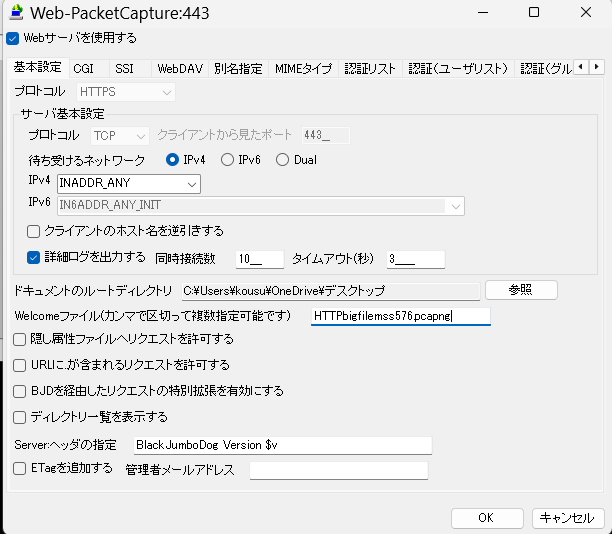
    Download large files from a browser using a protocol that does not congest the network.

    Because HTTP/HTTPS packet sizes are small, the time the line is monopolized is sporadic, unlike communications such as FTP.

    Use externally issued server certificates; self-signed certificates are not recommended.

    If a packet capture result file is specified as the welcome file, the download will start as soon as the web server is accessed.

    BJD is a paid service, but it is sufficiently mature, and a sufficient number of bugs have already been fixed.

    A lightweight screenshot tool with random intervals (1–5 minutes)

    This tool automatically captures snapshots of the PC screen at random intervals between 1 and 5 minutes and saves them to a designated folder.
    It is designed for lightweight visual logging of development, testing, and troubleshooting activities without the overhead of continuous video recording.

    What it does

    • Captures the entire main display at random intervals (1-5 minutes).
    • Many existing tools cannot record images at random interval timings.
    • Save the screenshot in PNG format
    • Allow users to choose where to save
    • Minimal interface with only three buttons

    Buttons

    • Select Image Storage Location
    • Start Recording
    • Stop Recording

    Intended use

    • Visual work logs for development and verification
    • Evidence collection for troubleshooting and reporting
    • Lightweight documentation without generating large video files

    File format and naming

    • Format: PNG
    • Example filename:
      Snap_YYYY-MM-DD_HH-mm-ss_fff.png
    • Optionally grouped by date in subfolders for easier navigation

    Behavior

    • After each capture, the tool waits a random duration between 1 and 5 minutes before taking the next snapshot
    • Recording continues until the user presses Stop Recording
    • If the storage location becomes unavailable, recording stops automatically to prevent silent failures

    This tool is intentionally minimal and built for clarity, reliability, and low system impact.

    Sound-Based Monitoring for Servers and Network Equipment

    I once deeply respected the diligence of the security personnel stationed at a data center. They noticed a reboot event by sound alone and reported it faster than any monitoring system. That experience reinforced a simple truth: the physical layer often speaks before dashboards do.

    This concept monitors the physical “voice” of infrastructure: fan noise, airflow tone, vibration-related sounds, and sudden acoustic events. A small sensor node (for example, a Raspberry Pi with an I2S MEMS microphone) measures acoustic level over time, stores the data as a time series, and visualizes it as a graph. When the measured level exceeds a defined threshold, the system can notify operators by email (or other channels) as an early warning.

    Logical monitoring (SNMP, syslog, metrics, logs) is already common. Sound monitoring is different: it observes the real-world environment around the hardware. In many on-prem environments—small server rooms, branch offices, clinics, factories, or shared racks—this “physical layer monitoring” can provide a practical safety net with minimal cost and complexity.

    The key value is not “audio recording,” but “state detection.” Operators do not need high-fidelity sound; they need a stable signal that reflects mechanical behavior. Even a simple time-series graph can deliver reassurance: if the baseline remains stable, operators gain confidence that nothing abnormal is developing. When the signal shifts, it can indicate a real-world change worth checking on-site.

    What this system measures (practical signals)

    • Average acoustic level over time (e.g., per 10 seconds / per minute)
    • Short spikes (sudden events) and sustained elevation (continuous abnormality)
    • Frequency-band energy (FFT) to detect “tone changes,” not only loudness

    Why sound monitoring can complement existing tools

    • Detects physical anomalies that may not appear in SNMP/logs at an early stage
    • Provides a “reality check” for on-prem rooms where full telemetry is not deployed
    • Supports human trust: “no change on the graph” is a form of operational reassurance

    Alerting and reporting

    • Email notification when the level crosses a threshold
    • Trend-based alerting (e.g., deviation from baseline rather than absolute dB)
    • Daily/weekly auto-generated graphs (PNG/PDF) for quick review by operators or executives

    Recommended sensing approach

    • I2S MEMS microphone for stable digital capture and reduced analog noise sensitivity
    • Small Linux node for continuous operation (low power, easy replacement)
    • Simple storage format (CSV/SQLite) to keep the system transparent and maintainable

    Where this is most useful

    • Small and medium on-prem server rooms without full-scale monitoring investments
    • Branch sites where “someone occasionally checks” is still the reality
    • Environments where physical deterrence matters: “We also observe the physical layer”

    What makes this idea viable as a product or service

    • Low cost per node and simple installation
    • Clear differentiation: a physical-layer signal that existing tools usually ignore
    • Easy integration into a broader offering (on-site inspection, cabling audit, operational reporting)

    Tips

    Pocketalk did not recognize “ARP” when I pronounced it as “āpu” in Japanese,
    so I had to pronounce it as “A, R, P,” letter by letter.

    “`html

    Technical Inquiry

    If this article relates to your network architecture, security design, or infrastructure modernization, feel free to contact us.

    Email:
    contact@g-i-t.jp


    Related Architecture Solutions

    Typical network architecture solutions designed and implemented by GIT. These patterns are derived from real enterprise environments and long-term operational experience.

    View Network Architecture Solutions
    Back to Home

    “`
  • Resilient Satellite-Backhaul Architecture for Interference-Prone Regions

    Resilient Satellite-Backhaul Architecture for Interference-Prone Regions

    Resilient Satellite-Backhaul Architecture for Interference-Prone Regions

    This document presents a carrier-grade satellite backhaul design optimized for post-conflict and interference-prone environments.
    The primary objective is not continuous uptime at all costs, but guaranteed recoverability under degraded power, packet loss, and intentional radio interference.

    This architecture does not compete with satellite connectivity providers.
    Instead, it provides an operations-resilient overlay that runs on top of existing commercial satellite infrastructure.

    Design Principles — Recovery Before Availability

    Non-Competitive Overlay on Existing Satellite Networks

    This design assumes the use of existing commercial satellite networks already operating in Northern Europe and adjacent regions.
    The goal is to strengthen operational resilience without competing with connectivity providers.

    Key principles:

    • Use existing satellite backhaul as the underlay
    • Provide resilience at the network-operations layer
    • Support multi-operator satellite environments
    • Avoid replacing or competing with satellite carriers
    • Deliver recovery-oriented design rather than bandwidth

    The system is positioned as an operations resilience layer, not a connectivity product.

    L3-First Overlay Architecture (EVPN/VXLAN)

    Traditional L2 extension across unstable infrastructure leads to cascading failures.
    Therefore, this architecture prioritizes Layer-3 VXLAN (L3VNI) segmentation.

    Core components:

    • EVPN control plane (MP-BGP)
    • VXLAN data plane
    • L3VNI for VRF segmentation
    • Minimal L2 extension (site-local only when required)

    Benefits:

    • Fault containment within VRFs
    • Prevention of broadcast storms and loops
    • Faster recovery after link degradation
    • Simplified post-outage convergence

    This approach ensures that local misconfigurations or infrastructure instability do not propagate across the entire network.

    Operations-First Connectivity (OAM VRF)

    Operational connectivity is isolated into a dedicated VRF:

    VRF-OAM (Operations and Management)

    Functions carried within this VRF:

    • Device management (SSH/HTTPS)
    • Telemetry and monitoring
    • EVPN/BGP control plane
    • Logging and diagnostics
    • Remote recovery actions

    Design rules:

    • OAM traffic shares the same satellite link as service traffic
    • Strict QoS prioritization ensures OAM survives congestion
    • Bandwidth requirements are minimal (sub-Mbps acceptable)
    • OAM traffic is strictly limited to recovery-critical functions
    • No large data transfers permitted in OAM VRF

    Even when service traffic collapses, recovery control remains available.

    Interference-Aware Satellite Operations

    Jamming-Resilient Control Behavior

    This design assumes persistent low-intensity radio interference such as:

    • Packet loss bursts
    • Latency fluctuations
    • Short intermittent outages
    • Throughput degradation

    The objective is not to defeat jamming at the physical layer, but to prevent network instability caused by control-plane overreaction.

    Key measures:

    • Conservative BGP and EVPN timers
    • Avoid aggressive failover triggers
    • Introduce hysteresis in path selection
    • Prevent control-plane flapping
    • Maintain stable session state under degraded conditions

    The system prioritizes stability under degradation rather than rapid failover.

    Minimal OAM Survival Channel

    Operational traffic is intentionally constrained to a minimal footprint.

    Allowed traffic:

    • Management access
    • Monitoring
    • Control-plane signaling
    • Emergency configuration actions

    Disallowed traffic:

    • Bulk log transfers
    • Backups
    • File transfers
    • Heavy dashboards
    • Continuous telemetry streams

    The objective is to ensure that OAM traffic remains viable under severe bandwidth constraints without congesting the satellite link.

    Failure Sequence and Recovery Order

    Recovery is orchestrated in a defined sequence:

    1. Power stabilization
    2. OAM VRF recovery
    3. Control-plane re-establishment
    4. Service restoration

    The design deliberately avoids attempting full service restoration simultaneously.
    Instead, it ensures that operators regain control first.

    Validation Using Cisco CML

    Simulation Environment

    Cisco Modeling Labs (CML) is used to reproduce the architecture and failure scenarios.

    Simulated conditions include:

    • High latency satellite links
    • Packet loss
    • Link instability
    • Interference-like degradation
    • Power interruption scenarios

    Failure Scenarios Tested

    Service Collapse Test
    Service VRF failure is induced while verifying that OAM VRF remains reachable.

    Interference Simulation
    Variable packet loss and latency introduced to emulate radio interference.
    Goal: prevent control-plane flapping.

    Full Outage Recovery
    Complete link loss followed by restoration.
    Recovery order and convergence time are measured.

    Automation and Reproducibility

    Configuration and recovery procedures are automated.

    • Legacy TeraMacro scripts translated into Python
    • Automated configuration deployment
    • Reproducible failure injection
    • Publicly documented test outputs

    This ensures that the architecture can be independently validated.

    Collaboration Model

    artnership with Satellite Operators

    This architecture is designed to operate in cooperation with existing satellite providers.

    Value delivered:

    • Operational resilience
    • Faster recovery after outages
    • Fault containment
    • Stable control-plane operation under interference

    The design does not replace satellite connectivity.
    It enhances survivability and recoverability.

    Deployment Context

    Applicable environments:

    • Northern European infrastructure resilience programs
    • Post-conflict reconstruction
    • Disaster recovery communications
    • Power-unstable regions
    • Carrier ground station operations

    Final Statement

    The goal of this architecture is not absolute uptime.

    The goal is recoverability.

    When interference persists,
    when latency fluctuates,
    when power fails,

    operators must retain control.

    Operations survive first.
    Services return second.

    That is the foundation of resilient communications in unstable environments.

    A Permanent Regional Backhaul Using One-to-Many GRE (mGRE) Without Encryption

    In regions where electrical power is unstable, satellite internet must be designed for survival rather than peak quality.
    Instead of pursuing traditional metrics such as throughput, latency optimization, or encryption-first security, this architecture prioritizes rapid recovery, minimal operational overhead, and tolerance for repeated device restarts.

    Our approach uses multipoint GRE (mGRE) as a permanent regional backhaul fabric.
    Encryption is intentionally omitted at the transport layer. This eliminates key rotation, re-negotiation delays, CPU overhead, and ongoing vulnerability remediation cycles tied to cryptographic stacks. The resulting network is simpler, more resilient to power loss, and easier to maintain across remote sites.

    The guiding principle is not to prevent interruption, but to ensure that communication returns immediately after interruption.


    What One-to-Many GRE (mGRE) Enables in Permanent Regional Links

    mGRE allows multiple remote sites to join a shared tunnel domain without defining fixed tunnel destinations.
    This removes the need to maintain separate point-to-point tunnels for each site and significantly reduces configuration complexity as the network grows.

    For permanent regional satellite backhaul, this means:

    • New sites can be added without restructuring existing tunnels
    • Sites can drop and rejoin after power loss without manual intervention
    • Routing adjacency can be restored quickly after restarts
    • The network does not depend on stable Layer-2 state

    The architecture assumes that outages will occur and focuses on rapid reintegration rather than continuous uptime.


    Why Transport-Layer Encryption Is Intentionally Omitted

    In unstable power environments, encryption often introduces more operational fragility than protection.
    Key exchange failures, CPU constraints, tunnel renegotiation delays, and security patch cycles can all delay recovery after a restart.

    By omitting IPsec and similar encryption mechanisms at the tunnel layer:

    • No key management infrastructure is required
    • Tunnel re-establishment is immediate after device reboot
    • Firmware updates are less urgent
    • Operational overhead in remote areas is minimized

    Sensitive payloads can still be protected at higher layers where necessary, but the transport itself remains lightweight and resilient.


    NAT and Carrier Constraints in Satellite Networks

    Satellite connectivity frequently involves NAT or carrier-grade NAT.
    This can interfere with traditional GRE operation and may introduce one-way reachability or session instability.

    The design therefore assumes that:

    • GRE transport must tolerate intermittent reachability
    • Keepalive mechanisms should be minimal and lightweight
    • Tunnel participation must be stateless and forgiving

    Where direct GRE transport is blocked, encapsulation adjustments can be applied without changing the overall architecture.
    The objective is not protocol purity but consistent regional connectivity.


    Mutual Broadcast Model Across the Regional Fabric

    Rather than forcing strict unicast recovery across unstable links, participating nodes can operate under a shared distribution model.
    Each site transmits into the shared tunnel domain, and receiving nodes selectively process relevant traffic.

    This does not rely on native Internet multicast routing, which is rarely available across satellite providers.
    Instead, the shared tunnel environment provides a controlled domain where traffic distribution can occur without maintaining strict Layer-2 adjacency.

    The result is a resilient communication pattern where nodes rejoin the network simply by re-establishing tunnel presence.


    Using Rendezvous Points to Assist Route Recovery After Outages

    To further improve recovery behavior in unstable power environments, the architecture incorporates a rendezvous point (RP) concept to assist with route re-establishment after node or link failure.

    In a permanent regional backhaul where sites may power-cycle unpredictably, routing adjacency alone is not always sufficient for rapid recovery. A rendezvous point provides a stable reference node that allows participating sites to rejoin the overlay fabric without needing full mesh awareness at startup.

    When a site comes back online after a power interruption:

    • It re-establishes its tunnel presence toward the rendezvous point
    • The rendezvous point serves as a temporary traffic convergence anchor
    • Routing information can be re-learned incrementally
    • Traffic can flow via the rendezvous point until optimal paths are restored

    This model does not require strict multicast routing support from the underlying carrier.
    Instead, the rendezvous point functions as a logical convergence node within the overlay, helping stabilize routing during periods of churn.

    The rendezvous point can be implemented as:

    • A central hub within the mGRE domain
    • A lightweight control-plane anchor
    • A temporary forwarding node during reconvergence
    • A regional aggregation site

    Once connectivity stabilizes, traffic may again flow directly between sites if routing policy permits.
    The rendezvous point remains available as a fallback convergence mechanism during future disruptions.

    By incorporating a rendezvous-based recovery assist mechanism, the network gains an additional layer of resilience.
    Rather than requiring all sites to rediscover one another simultaneously after outages, each site only needs to regain contact with a known anchor.
    This reduces reconvergence time and supports predictable restoration of regional connectivity.


    Operational Priorities for a Permanent Regional Satellite Backhaul

    To maintain stability across a long-lived regional deployment, the network is designed around predictable recovery rather than continuous uptime.

    Key priorities include:

    • Minimal configuration state per site
    • Fast reintegration after power restoration
    • Reduced dependency on ARP or MAC learning
    • Simplified routing convergence
    • Clear separation between monitoring and transport

    This approach allows the infrastructure to remain functional even as individual nodes restart, relocate, or temporarily disconnect.


    Strategic Positioning

    By publicly acknowledging that traditional quality metrics are not the primary design goal in unstable-power regions, this architecture establishes a distinct operational model.
    Later entrants may focus on performance improvements, but the foundational backhaul layer—designed for persistence and rapid recovery—remains in place.

    This positions the network as a permanent regional communication fabric rather than a performance-optimized link.

    “`html

    Technical Inquiry

    If this article relates to your network architecture, security design, or infrastructure modernization, feel free to contact us.

    Email:
    contact@g-i-t.jp


    Related Architecture Solutions

    Typical network architecture solutions designed and implemented by GIT. These patterns are derived from real enterprise environments and long-term operational experience.

    View Network Architecture Solutions
    Back to Home

    “`
  • Monitoring tools do not have to be engineer-only. They can be customized for executive assistants and management.

    Monitoring tools do not have to be engineer-only. They can be customized for executive assistants and management.

    Monitoring tools do not have to be engineer-only. They can be customized for executive assistants and management.

    Fully real-time alerting combined with AI-assisted log analysis enables detailed operational insight without relying on individual expertise.

    Zabbix as the Core Monitoring Platform

    This approach reduces operational risk while preserving full transparency of monitoring data.
    Our monitoring architecture is built around
    Zabbix, an open-source enterprise monitoring platform used globally in data centers and corporate networks.

    Zabbix allows us to implement:

    • Server monitoring
    • Network monitoring
    • SNMP monitoring
    • Syslog monitoring
    • SLA visualization
    • Custom dashboards
    • Real-time alerting

    Because Zabbix is open-source and vendor-neutral, the monitoring environment remains transparent and maintainable over the long term.


    Monitoring Designed for Non-Engineers

    Traditional monitoring systems are often designed only for engineers and require deep technical interpretation.

    We redesign Zabbix dashboards so they can be used by:

    • Executive assistants
    • Operations coordinators
    • Management teams

    Dashboards can display:

    • Service health indicators
    • Site availability
    • Critical alert counts
    • Monthly uptime metrics
    • Simplified status panels

    This enables:

    • First-line monitoring by non-engineers
    • Clear escalation procedures
    • Reduced operational overhead for executives

    Monitoring should support decision-making, not burden leadership with technical interfaces.


    Real-Time Alerting

    Zabbix supports fully real-time detection and notification.

    Typical monitoring targets include:

    • VPN status
    • WAN latency
    • Packet loss
    • Server resource usage
    • Network device status
    • Routing events

    Alerts can be delivered through:

    • Email
    • Chat systems
    • Webhooks
    • Notification gateways

    This ensures that incidents are reported immediately rather than discovered retrospectively.


    AI-Assisted Log Analysis

    Real-time alerts alone are not sufficient if log interpretation depends on a specific engineer.

    Our approach combines:

    • Standard CLI log retrieval
    • Plain-text log storage
    • AI-assisted analysis when required

    Typical workflow:

    1. Zabbix detects an anomaly
    2. Secure login to the device
    3. Execute standard log command
    4. Retrieve plain-text logs
    5. Analyze manually or with AI assistance

    By keeping logs in readable text format, the system avoids dependency on proprietary parsers or custom software.

    AI assistance allows:

    • Rapid summarization of large logs
    • Identification of critical events
    • Pattern recognition
    • Report preparation

    This significantly reduces operational dependency on individual engineers.


    Reporting Capabilities

    The monitoring environment can generate structured reports using:

    • Graphs
    • Availability statistics
    • Alert summaries
    • Performance trends

    Reports can be delivered in:

    • PDF format
    • Graph-based summaries
    • Executive reports
    • Periodic operational reviews

    These reports help management understand:

    • System reliability
    • Incident frequency
    • Infrastructure trends
    • Operational risk

    without requiring technical interpretation of raw logs.


    Maintainability and Transparency

    We intentionally avoid proprietary monitoring systems that create long-term vendor dependency.

    Instead, we design monitoring environments based on:

    • Open-source platforms
    • Standard protocols
    • Human-readable logs
    • Transferable operational procedures

    This ensures that the monitoring system remains understandable and maintainable even if personnel change.

    Monitoring systems should remain operable and auditable for years, not just during initial deployment.


    Scalable Architecture

    The same monitoring design can scale from:

    • Small offices
    • Multi-site enterprises
    • Data centers

    without requiring replacement of the core platform.

    Because Zabbix does not rely on per-device licensing, the system can grow without exponential cost increases.

    Data Center Audit: Conducted by the executive and his/her team of assistants

    Deterrence created when a CIO visually inspects each individual connection

    To maintain a visible on-site presence and keep operations disciplined.
    To ensure that negligence or sabotage does not go unnoticed.


    When conducting a data center audit, the external appearance—particularly the cable routing and termination—will likely become the central focus of the inspection.
    In many of the data centers we have been involved with, we have witnessed “severely problematic” cabling on two occasions over the past 20 years.
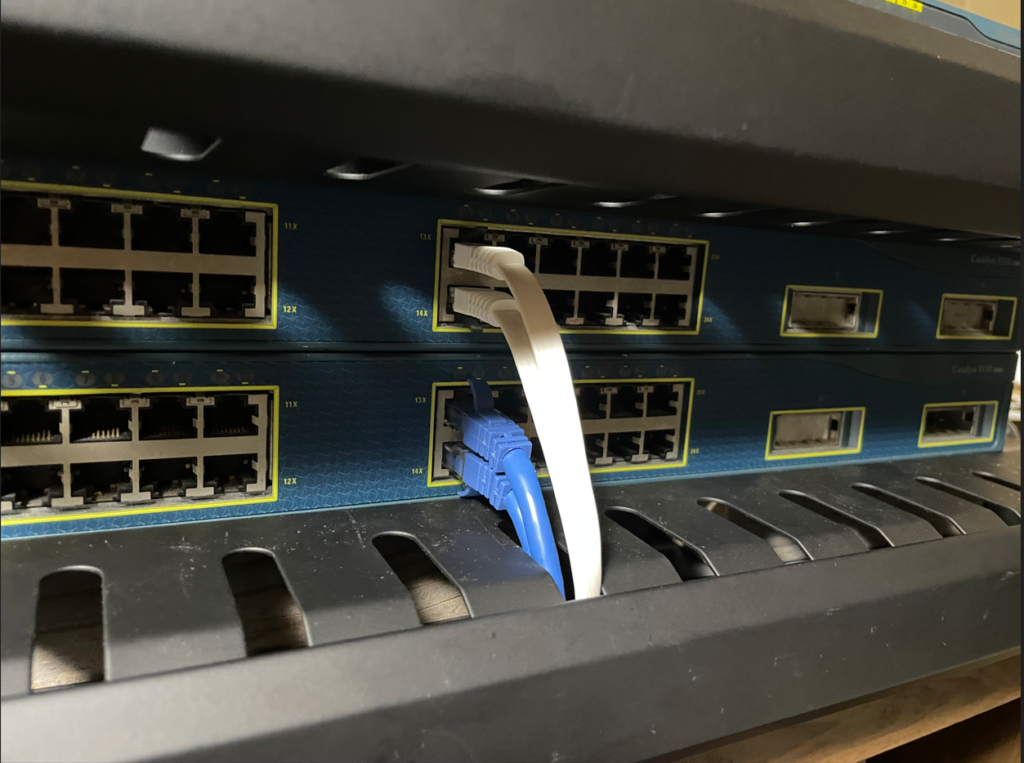
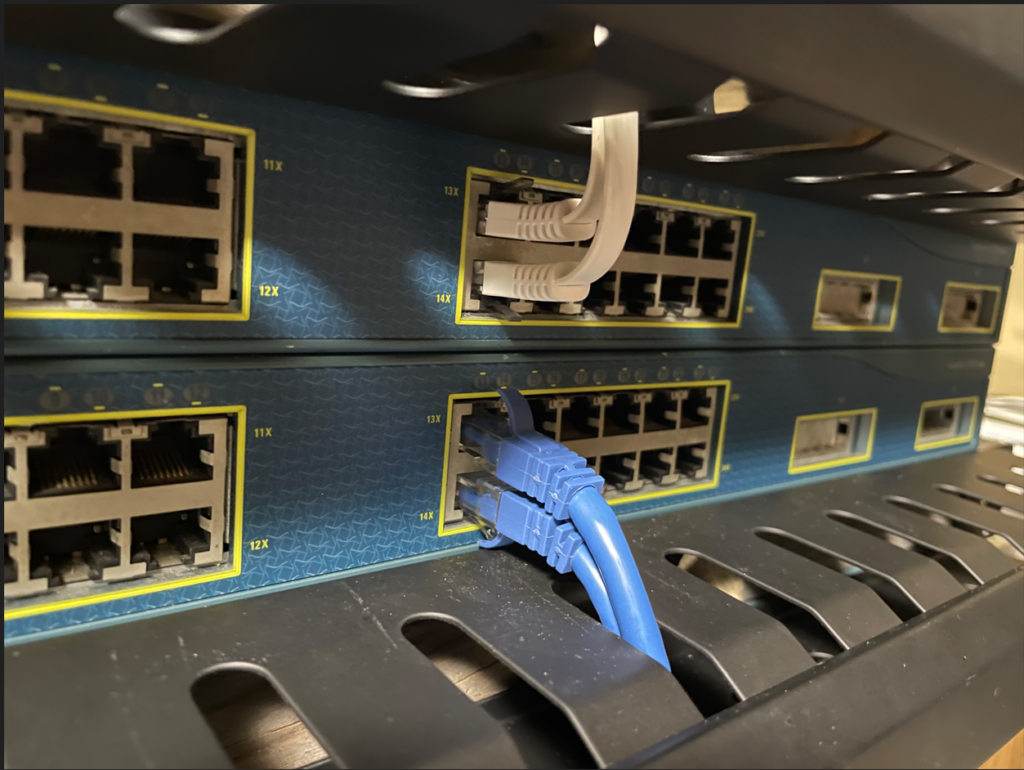
    (The example shown here is a simplified reproduction created within an environment under our supervision.)

    First, we present an example of incorrect cabling.

    Reason this is incorrect:
    If the lower device fails, the upper device would also need to be removed in order to access it.
    If these two units are configured in a redundant pair, both the primary and secondary systems would end up being removed together.

    Although the number of cables in this sample photo is limited, most machines in commercial operation typically have a much higher cable count.
    If the number of cables is low, it often means that the cost of each available port is being underutilized.

    Site inspections conducted by executive leadership should also incorporate a cost-efficiency perspective.

    Next, we present an example of proper cabling.

    With this approach, either the primary or the secondary unit can be replaced independently in the event of a failure.

    “`html

    Technical Inquiry

    If this article relates to your network architecture, security design, or infrastructure modernization, feel free to contact us.

    Email:
    contact@g-i-t.jp


    Related Architecture Solutions

    Typical network architecture solutions designed and implemented by GIT. These patterns are derived from real enterprise environments and long-term operational experience.

    View Network Architecture Solutions
    Back to Home

    “`