Personal Heuristics for WBS Optimization
Disclaimer
The following items are based on personal field experience. They are presented as practical heuristics rather than formal theory.
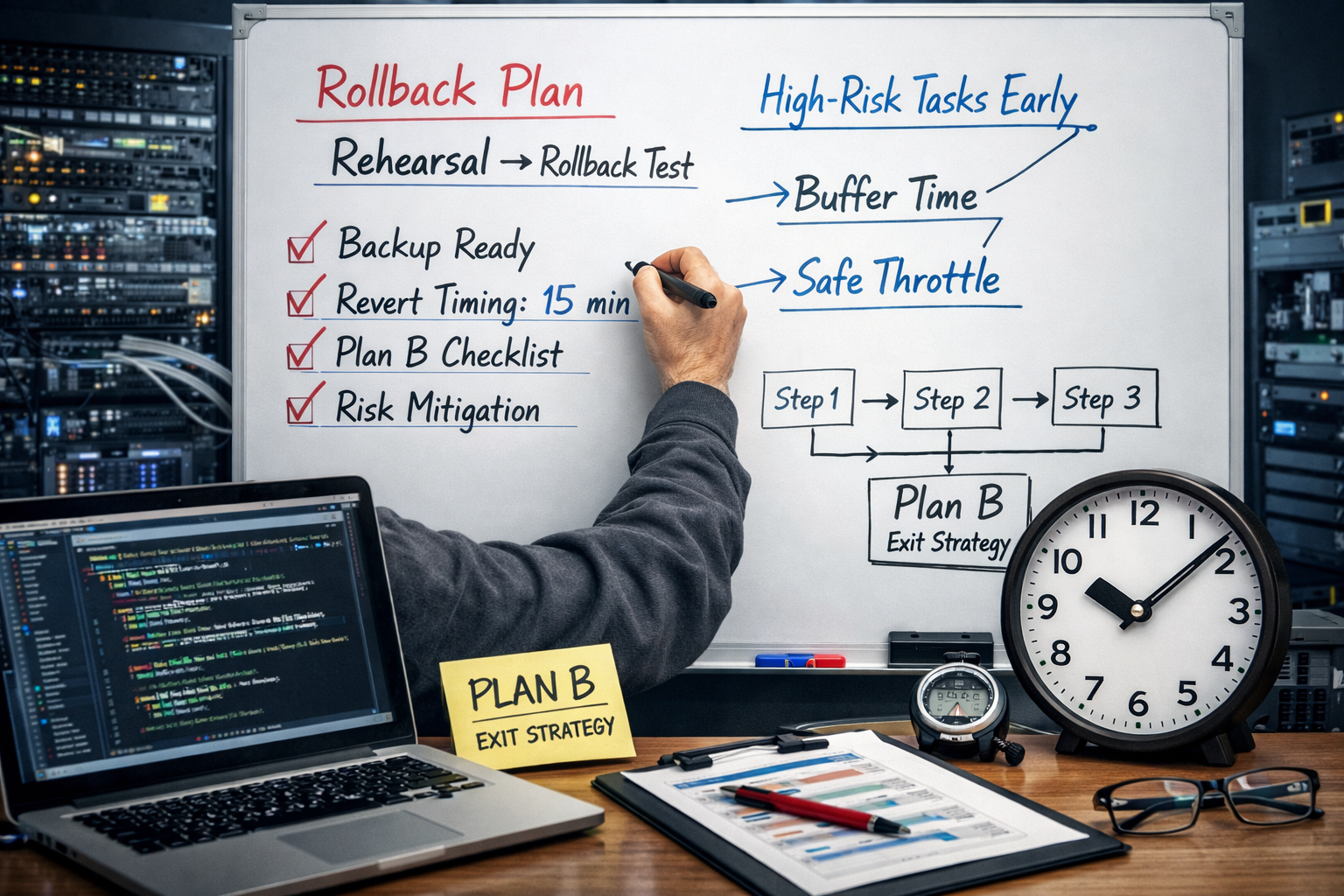
Always Rehearse with a Planned Rollback
When performing a rehearsal, we assume from the outset that a rollback will occur. The rehearsal is executed with a predefined rollback plan, and we verify in advance not only the rollback procedure itself but also the accuracy of the estimated rollback duration.
This ensures that when a real rollback is required, both the method and the time required are already validated.
Execute Risky Tasks Early in the Process
High-risk tasks are intentionally placed in the early stages of the workflow.
Because fewer changes have accumulated at that point, the rollback scope remains small. This allows rollback operations to be performed rapidly and accurately if needed.
Allocate Generous Time Buffers in Early Steps
We assign larger time buffers to preceding steps.
As work progresses, unused buffer time accumulates. This creates increasing temporal and psychological margin, allowing the team to operate with greater stability and clarity as the project advances.
Maintain a Sustainable Throttle Margin
Our guiding principle is:
Prepare for trouble in advance.
Do not run at full throttle.
Maintain the throttle setting that allows the longest possible range.
Rather than pushing systems or teams at maximum capacity, we operate at a sustainable level that preserves maneuverability. This ensures that when unexpected issues occur, there is always room to respond, adjust, and recover without loss of control.
“`htmlTechnical Inquiry
If this article relates to your network architecture, security design, or infrastructure modernization, feel free to contact us.
Email:
contact@g-i-t.jp
Typical network architecture solutions designed and implemented by GIT. These patterns are derived from real enterprise environments and long-term operational experience.
“`
コメントを残す