[Testing the Effects of Exposing Motors and Electronic Circuits to Radiation]
For me, the most crucial theme is “preventing the exploitation of vulnerable members of society.” That is the exact trigger for the bizarre experiment described below.
(Please note it is intentional that the text on this page is written in a way that “only those who need to understand it will understand it.”)
“Vulnerable people must be being made to work covertly at nuclear-related facilities. Therefore, we must automate these operations to eliminate human presence.”
This is the starting line of my experiment. (While there have been media reports about such covert labor in France, regarding Japan, it remains my own speculation.)
The method for automation is simple: attach two arms to a remote-controlled (RC) tank, and connect bolt sockets or wrenches directly to the motors to act as “fingers.” If the environment has four different types of bolts, you simply give it four fingers.
I am committed to absolute simplicity. I will not pursue spin-offs, because “generating various insights as side benefits” is not my goal. My goal is exactly as I stated above.
Alternatively, the four motors for the bolt sockets could all use the identical socket type, configured purely as a redundant system. (A total of four components: two identical jacks and two identical plugs.) Since Torx drives can also turn hex bolts, Torx is the definitive choice for the sockets.
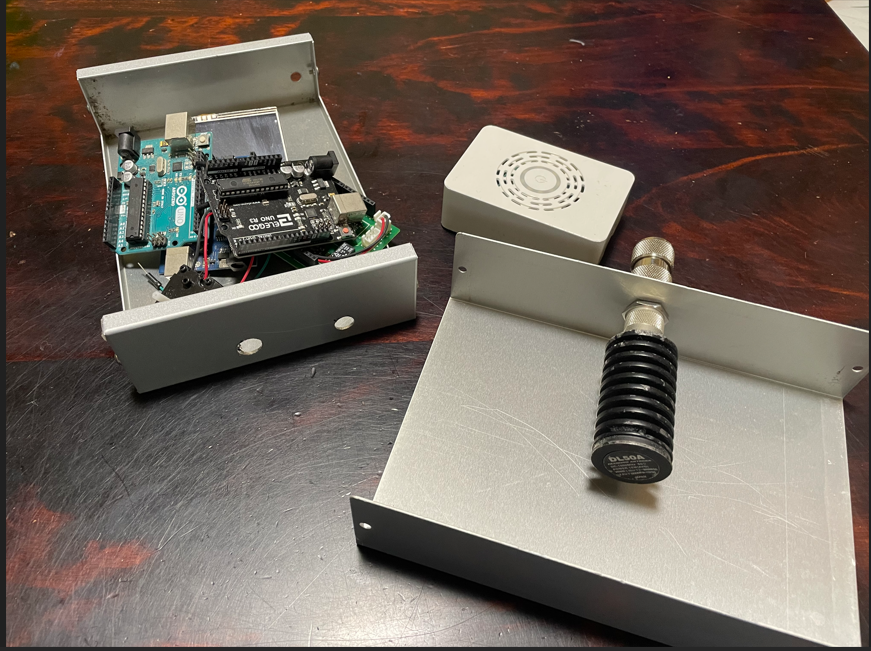
Before assembling the actual robot, I built the setup shown in the photo below. It connects two Arduino or Raspberry Pi units to transmit and receive data, measuring whether or not they can maintain signal communication under high electromagnetic field environments.
Two motors are connected face-to-face using bicycle valve rubber (mushi-gomu); one acts as a motor (power source) and the other as a generator. Under a high electromagnetic field environment, a tester equipped with a data logger measures how the generator’s RPM—meaning its voltage—changes with and without radio wave exposure.
*Note: The passive-side motor is installed outside the metal enclosure.
Alternative Approach for a Radiation Irradiation Device
For this, an amateur (ham) radio transmitter is utilized.
The black cylinder on the right side of the photo below is a device designed to “create impedance using only resistance ($R$),” commonly known as a dummy load.
Since it relies purely on $R$, the electromagnetic waves that reach it are converted entirely into heat. However, according to Monica, the electric field strength of the radio waves leaking from the dummy load is more than sufficient. For the dummy load, instead of just ensuring a “solid earth ground” or a standard “chassis ground,” I obsessed over “establishing a null point.” Monica states that a 50W FM output at 430 MHz is plenty for the frequency and power.
First, achieving the result of “We blasted it with radio waves and it broke” will be our initial success. Once we achieve that, we will begin exploring methods for shielding and defense.
Even if a certain nation were to stockpile window air conditioners and camping batteries, it could hardly be classified as an increase in military spending.
Furthermore, if we equip that remote-controlled (RC) tank with a Wi-Fi repeater, it effectively becomes a “Wi-Fi Repeater Tank.”
My understanding is that inside a rented anechoic chamber, the enclosure housing the measuring instruments must have sides measuring $\frac{1}{2}\lambda$ or less to prevent electromagnetic waves from penetrating. While we could use water server bottles to block the electromagnetic waves, using an “Itto-kan” (a standard Japanese 18-liter square tin can) with the lid cut off and filled with water would make putting the instruments in and out much easier. Thanks to the water, the half-wavelength of a 2.4 GHz signal calculates out to just 0.7 cm.
Even if satellite internet becomes unusable due to an EMP (Electromagnetic Pulse), we can simply line up repeaters on the ground, step by step, to maintain connectivity.
A system capable of operating continuously in high-radiation environments might just yield unexpected spin-offs after all.
However, let me declare this here and now: The machinery currently under development is strictly a “Disaster Relief Device.” I have absolutely no desire to complicitly participate in what people call “military-civilian cooperation.”
Amateur radio operators should always strive to be amateur diplomats.
■ Radiation Shielding Methods (Substituted with 430 MHz FM 50W)
The transmitter will be switched to one designed for Digital Simple Radio (DSR). This ensures it will no longer conflict with the Radio Act’s provision regarding operations being “solely for non-profit/non-commercial purposes.”
Furthermore, utilizing this type of radio enables voice communication without relying on the internet. For any conversations we wish to keep secure from third parties, we will use voice scrambling features. Once contact is established via radio, it will also be possible to meet up physically in person.
*Note: I do not want any comments on this blog. Even if people try to nitpick or criticize, I will not bother reading it at all.
Using a “Water-Cooling Mechanism” to serve both heat dissipation and radiation shielding functions.
- Challenges:
- Requires pure water or a non-conductive coolant.
- Design Starting Point (Milestone-level):
- PC water-cooling setups should be reasonably priced.
- Miscellaneous:
- GPUs used to be cheap too. Adapting mass-produced goods is essential.
- A certain amount of weight is necessary to act as a “counterweight” when moving the robot arms.
- Therefore, we will fit crawlers (tracks) onto a commercially available window air conditioner and convert it to electric drive.
- Purchasing a PC-specific water-cooling setup will be put on hold for now.
【New Challenge】
In that configuration, can it navigate through a pile of rubble?
$\rightarrow$ For this project, the premise is operation inside a facility before any accident occurs. Therefore, dealing with rubble is outside the scope of consideration.
We will assume that for airtight sealing, we only need to seal off the sections where “liquid comes into contact with the air.”
■ Testing the irradiation of electromagnetic waves on the window air conditioner will utilize Tokyo Metropolitan Government facilities (rented anechoic chambers).
*We will use metropolitan subsidies to minimize the rental costs.
■ Regarding the Pure Water Used in Testing (80 M$\Omega$ is unnecessary): Addendum (19/05/2026)
The RO (Reverse Osmosis) water you can pump at the supermarket for a one-time bottle fee of just 500 yen apparently uses the exact same physical protocol as laboratory pure water purification systems (like Millipore) and seawater desalination systems on nuclear submarines.
To ensure I never lose sight of the project’s purpose, I am posting the ultimate goal of the design—the ad copy—with this timestamp:
Project Vision / Ad Copy
This system is not designed for post-accident collapse sites (rubble environments). Instead, it assumes the total automation of completely unmanned bolt-fastening and maintenance operations within a highly managed, peacetime, state-of-the-art clean facility located hundreds of meters underground within bedrock, where high-level waste is permanently emplaced and sealed over the extremely long term.
*The development plan below will be reworked from a zero-base perspective. However, any future ideas that come to mind will be appended to the memorandum section above, as past ideas may still prove useful later on.
【Development Plan】
*Since development follows an agile approach, this entire article may eventually be moved to Git.
*If we are unable to successfully induce a “broken” state in the steps below, we will record the specifications of the electromagnetic transmitter and its “distance from the target.” If it does break, we will proceed to the next phase only after a countermeasure has been finalized.
Phase 1 Goal
- Establish an environment where the following equipment can be successfully “broken” when blasted with electromagnetic waves. The target devices are as follows:
- Arduino / Raspberry Pi and Webcams
- Camping batteries
- Wi-Fi converters*At this stage, anechoic chambers will not be used; verification will be conducted inside an “aluminum box.”
Phase 2 Goal
- Establish an environment where the following equipment can be successfully “broken” when blasted with electromagnetic waves. The target devices are as follows:
- Electric screwdrivers (The sockets will be “Torx” to align with European standards.)
- Robot arm (For the payload capacity, only the weight calculations will be done in advance.)
Phase 3 Goal
- Establish an environment where the following equipment can be successfully “broken” when blasted with electromagnetic waves. The target devices are as follows:
- A crawler capable of moving the same weight as the equipment built in the previous phase.
Moving forward, it is preferable not to enter the physical production stage until the design is complete; however, we will conduct physical machine verifications on a case-by-case basis using an agile approach.
■ Each time these articles are updated, they are archived with careful consideration not only for the Electronic Bookkeeping Act (Dencho-ho) but also for TPM and the cloud upload timestamps. ■
■ All “past versions” are also fully preserved and saved on OneDrive. ■