I believe that exceptional originality is not necessarily a prerequisite. Rather, our philosophy is simple: the greater the variety and creativity of the products—meaning, the larger the number of designers involved—the higher the probability that “one of them will hit the jackpot.”
(Note: “K.K. GIT” is our unique corporate abbreviation, established with international accounting standards in mind. Since this exact notation does not exist overseas, it is distinct from and will not be confused with mainstream global IT brands.)
[Preceding Context: “All you need to do is speak your mind.”]
All you need to do is state your wish list: “I wish we could do this,” or “It would be great if we could do that.” In our industry, we call that “designing.” Intellectual property rights belong to the visionary—the person who simply spoke their mind.
Imagine yourself at a shareholders’ meeting, proudly and passionately articulating the fact that you designed the system. That is exactly the kind of DX (Digital Transformation) support service I provide.
[Main Text]
The suite of applications we have developed bypasses traditional operations, establishing a direct link between network equipment, engineers, and executive management. This enables radical optimization of outsourcing costs and labor expenses—shifting your IT architecture from a mere “cost center” to an “offensive, growth-driving IT asset.”
Our Core Network Design Advantage: We offer a proprietary design capable of reducing any network architecture down to a bare minimum of two devices.
- Simply put, we connect servers directly to a Firewall/UTM equipped with a high density of physical ports (LAN interfaces).
- This streamlined configuration allows routine maintenance workflows to be thoroughly standardized into a single, predictable pattern.
Furthermore, we offer a design that enhances IT security by integrating just one or two network devices. I will elaborate on this further down in this article.
Does investing in IT genuinely reduce your tax burden? This is a point that is widely misunderstood in the business world. Have you ever considered what acquiring assets actually means from a tax perspective? Have you evaluated what happens to your ROA (Return on Assets) when you aggressively reduce assets? Perhaps the strategic priority should not be “investment,” but “reduction.” We do not view this as tax avoidance; as your profits grow, your corporate tax contributions will naturally rise in tandem.
(Note: We champion the optimization of human resources by shifting talent from cost-center IT departments to revenue-generating IT roles. Please note that strategic cost optimization and workforce downsizing/layoffs are entirely different concepts.)
Our core objective is to reallocate human resources from routine IT maintenance to front-line, business-facing roles. As DX becomes ubiquitous, the talent required on the front lines demands “creativity and originality” rather than a strict “aptitude as a conventional programmer or systems engineer.” Personnel previously dedicated solely to monitoring should be elevated to more creative, high-value operations. From hardware to people—isn’t it time to shift the focus of your investment?
The Application Architecture
To put our application’s design philosophy simply: It immediately alerts executive management and the secretariat directly the moment an anomaly occurs in the network equipment.
Once management is notified, a top-down directive for verification flows straight down the chain. This tool embodies a design philosophy that fundamentally departs from traditional operational processes.
Technical Mechanism (Simplified):
- Connect a PC to the IP segment designated for network equipment management/monitoring (via VPN).
- The system triggers a log entry upon receiving an SNMP-Trap.
- The system triggers a log entry when a Ping fails (NG).
- It monitors designated directories and raises an alert whenever a log entry increases.
Regarding delivery methods such as email or chat notifications, “security policies vary significantly by client.” Therefore, we plan to co-develop these solutions with each client through our DX support model once specific demands are identified. We believe in efficiency and do not expend operational resources before a contract reaches a high probability of close.
The applications function seamlessly either as a three-part suite or as standalone tools. We have already partnered with Copilot to begin consolidating them into a single, unified application. We intentionally utilize Copilot because “there is a high probability that the client has already adopted it.” We aim to leave the development environment fully intact within the client’s infrastructure, empowering them to perform self-directed customization in the future.
Brief Technical Specifications:
- We deliberately bypass Syslogs, which generate logs continuously during normal operations. Instead, we generate logs only upon receiving an SNMP-Trap, which (theoretically) fires exclusively during anomalies. (The log records the source IP and the packet’s exact timestamp).
- A log entry is generated when a Ping connection is dropped consecutively for 15 seconds.
- When the volume or size of logs increases, an automated alert is dispatched via email or preferred channels.
- We are also developing a feature to notify users at fixed intervals when log counts or sizes have not increased (serving as an automated “heartbeat” or “all-clear” status).
Regarding SNMP-Traps, technical details often remain ambiguous even after applying the MIB to the monitoring device. For this reason, we “strip down” the log content to retain only the essential data: the source IP and the packet arrival time.
Moving forward, we plan to expand our product lineup utilizing this “log-increase” mechanism. To maximize our clients’ ROI, we will package each capability as an independent product. Example: A dedicated feature that notifies users at designated intervals that there has been zero change in file count or size.
The only infrastructure required between management and engineers is a direct line of communication. We encourage you to call your engineer’s mobile phone directly.
[Column] Why We Refuse to Build “All-in-One” Tools
The reason boils down to one metric: ROI. Adding features beyond “what is necessary at that exact moment” inevitably inflates the procurement cost. To maximize our clients’ ROI, we are obsessed with “reducing features to the absolute limit.” Our goal is to deliver outcomes that allow you to say, “Look at the profound business impact we achieved with an investment of just a few dollars.”
[Our Strategic Approach to Security Design]
As mentioned earlier, we possess a design framework that enhances enterprise security by adding just one or two network devices. This is achieved via a Transparent Mode UTM—essentially a machine that functions as a Layer 2 switch while simultaneously packing the advanced capabilities of a UTM. We deploy it at the edge, “physically closest to the internet.”
Transparent Mode allows organizations to implement triple, quadruple, or deeper multi-layered defense architectures simply by “adding a few units.” It blocks malicious traffic at both ingress (incoming) and egress (outgoing) points. Even if a internal router, PC, or server suffers an intrusion or infection, this design prevents it from being weaponized as a stepping stone to launch external attacks.
[The Ultra-Low-Cost Alternative]
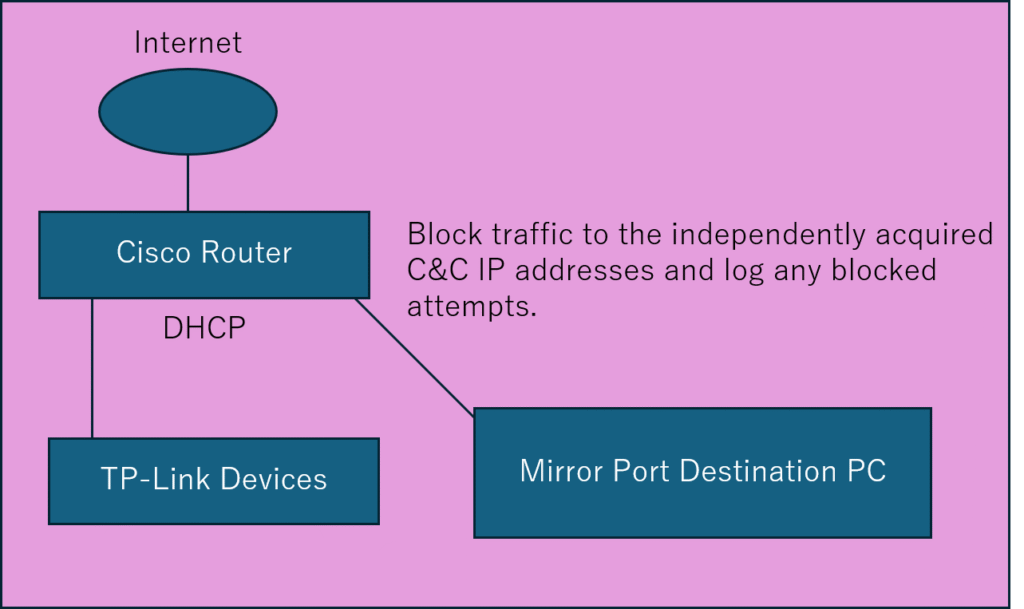
We can implement the configuration illustrated below. However, because we cannot guarantee the absolute reliability of the “high-risk IP address intelligence” obtained independently, this is not a configuration we officially recommend for enterprise environments.
Since this setup deliberately leverages “TP-Link” equipment—which local governments across Japan have actively begun phasing out and replacing—we treat this strictly as a configuration for internal validation within our own test environments. Furthermore, because this “high-risk IP address list” cannot be made public, ongoing maintenance by our team becomes mandatory. When factoring in these specialized maintenance fees, it may ultimately become a solution that does not “feel” low-cost at all.
In that scenario, it could paradoxically result in the lowest cost-performance ratio—incurring expenses for the frequent on-site visits required, not to mention the billable hours spent over coffee and casual consultation.
[Under Development: A Testing Tool for Simulating Outbound Traffic to High-Risk IP Addresses]
*Note: This tool is designed to be executed exclusively within an isolated environment with no outbound internet connectivity.
*Note: We are currently refining the architectural design to make this tool even more secure.
Key Requirements:
- Zero Overhead: If the tool is left to run unattended overnight, the labor costs for that shift are effectively zero.
- This is the primary reason we do not utilize existing freeware like NMAP. We refuse to incur any labor costs for our clients, even for the initial configuration phase.
- Hard-Coded Destination Data: By hard-coding the destination information, we raise the barrier to entry for potential data theft. (This approach requires operational policies that strictly prohibit unauthorized packet capturing).
- The current challenge here is that those with the right skillset can still reverse-engineer it.
- Ultra-Minimalist UI: The interface consists solely of a “Send” button and provides no status indicators. (It features exactly two buttons: one for sending one packet every 10 seconds, and one for a simultaneous broadcast).
- Disposable Architecture: We intend for the tool itself to be “disposable.” In practice, this will require measures that prevent file transfers from the testing PC.
- Ideally, we want the application to self-delete after a single execution—though making a tool behave that way starts making it look suspiciously like malware itself… [laughs]
[A Solution to Bring Internet Costs Down to $5 a Month]
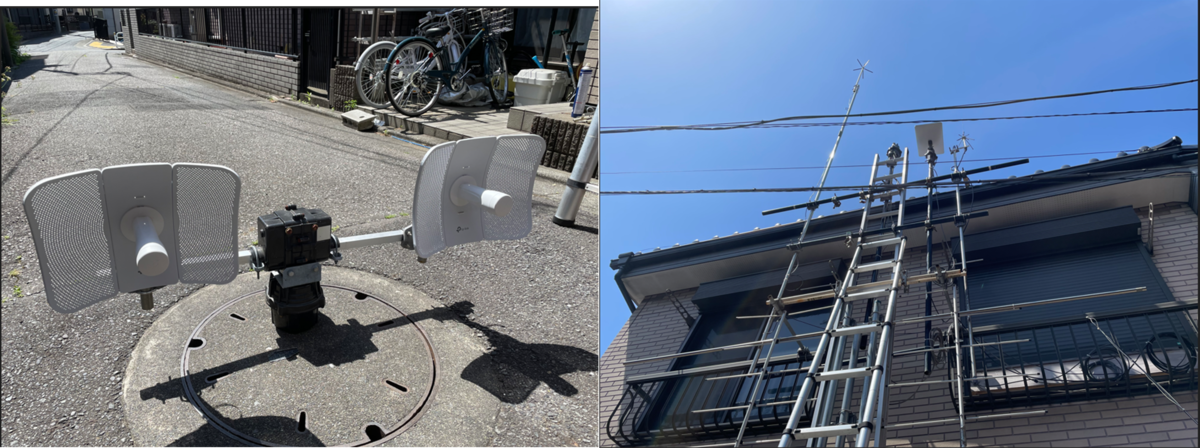
The parabolic-antenna-style Access Point (AP) shown in the photo below is designed with a specific goal in mind: to build a network that drives internet costs down to roughly 500 yen (approx. $5) per month. (Please note that the setup shown is a temporary assembly for photography purposes.)
However, this parabolic AP is also a TP-Link product. Monitoring the radio waves on the WAN side of this setup feels legally precarious. Under Japanese communication laws, while anyone can theoretically intercept “communications directed to specific parties” (though disclosing or publishing them is strictly prohibited), decrypting data on a network for which you hold no ownership or rights is fundamentally illegal. Since the uplink side connects to a public Wi-Fi network, the demarcation line becomes grey—meaning it is a boundary we cannot legally cross. (As for whether this is “technically” possible or not, I will plead the fifth! [laughs])
The fact that the AP is mounted on a dual-axis rotator, with a Starlink antenna intentionally captured in the background, is entirely by design. To put it simply, I love a down-to-earth lifestyle. I currently live in an area that looks remarkably similar to the landscape where I grew up as a child. My immediate goal is to contribute to this local community by paying taxes generated from foreign currency earnings.
On a side note, it seems that mainstream media outlets have completely failed to report on the looming risk that high-purity silicon—the essential raw material for semiconductor silicon wafers—might stop flowing into Japan. The shipping routes and maritime logistics chains for this material appear to be invisible in public discourse. There is zero coverage on which countries we need to cooperate with, or how we should go about it. Naturally, you won’t find a single thing about this on social media either. Yet, that counterparty is in such dire straits that subsidies are actively being issued to them.
[Breaking News] 18/05/2026
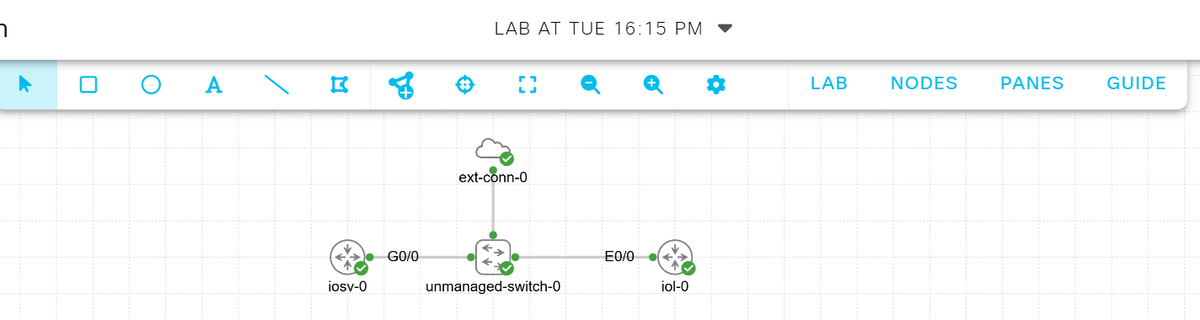
We have successfully completed the setup of CML (Cisco Modeling Labs, Cisco’s official simulator). *While the deployment process was a saga of trials and tribulations worthy of several pages, I will spare you the details for now.
Moving forward, we plan to leverage CML to publish the following technical resources:
- A Collection of Python Code Snippets for SD-WAN (This will serve as a direct translation of TeraMacro into Python scripts).
- Network Architectural Designs for Deploying L2VPNs in Regions with Unstable Power Grids.
[Upcoming Verification: Testing the Effects of Radiation on Motors and Electronic Circuitry]
For me personally, the most critical core theme is “preventing the exploitation of the socially vulnerable.” This is the exact catalyst for the unique experiment detailed below.
I originally had no intention of publishing highly technical articles on this specific page. However, since the latest posts automatically appear at the very top of our blog, I am placing this entry here to maintain the site’s structural balance. (Please note that it is entirely intentional that the content on this page is written in a specialized manner, tailored for those with the appropriate technical background.)
The conceptual starting point for this experiment is a compelling hypothesis: Socially vulnerable individuals may secretly be subjected to labor conditions within nuclear-related facilities. Therefore, we must completely automate and unmanned these operations. (While investigative reports regarding such clandestine labor have surfaced in France, its existence in Japan remains a matter of my own inference and concern.)
*Note: This article has been relocated to the link below.
[Development Diary] Operating a Tracked Wi-Fi Repeater in High-Radiation Environments.
In connection with this development, we are launching the following new service. (A dedicated product and service catalog page will be available at a later date.)
[New Service Launch: Anechoic-Equivalent Environment Surveying]
- Streamlined Testing: We keep the process highly efficient by utilizing an analog spectrum analyzer for all measurements.
- Cost-Effective Alternative: We offer this service at a price point more affordable than renting a formal anechoic chamber (which typically starts at around 5,600 yen per hour at public facilities in Tokyo).
- Transparent Travel Expenses: On-site travel expenses will be billed directly at actual cost.
*Note on Time-Series Observations: If continuous monitoring over time is required, we track the screen of the measurement management PC using Winshot at regular intervals. Whether there are thousands of captured images or just a few, we instantly compile them into a PowerPoint presentation via our proprietary VBA script, which serves as your comprehensive observation report.
[Our Overall Strategic Vision]
We are actively exploring ways to extend our specialized services to foreign corporations that do not maintain a PE (Permanent Establishment) within Japan.
Moving forward, we will be significantly shifting our corporate focus and amplifying our resources toward this objective.
“We do architecture/advisory, not managed operations.”
“Best effort”
“Validation-based recommendation”
“Customer-owned operation”
Future Challenge: To provide a clear, upfront pricing list.
Example:
Probing / Penetration Testing for UTM
- Deployment Tools: NMAP / OWASP ZAP / Burp Suite
- Deliverables (Report Content):
- Scan reports generated by the aforementioned tools.
- Wireshark packet capture screenshots from the receiving PC/Server.
- OS Stealth Verification Report: We can provide verification reports confirming that the target OS is successfully concealed/stealthed against NMAP OS scanning attempts.
- Pre-deployment Downtime Measurement & Unavoidable Interruption Verification:
- Measurement of exact network downtime prior to integrating new hardware.
- Advance verification and validation of specific traffic paths where interruptions are strictly unavoidable.
- On-Site Demonstration: Available at the customer’s office upon request.
- Pricing Matrix for Migrating Existing FW Configurations to a Transparent Mode UTM:
- Price scales based on the number of policy lines and the utilization of object-oriented configurations.
- Real-device port scanning execution is strictly mandatory for this deployment pattern.
Technical Draft: Architectural Considerations for L2VPN Underlay Routing Protocols (Added on 20/05/2026)
For connectivity with international networks, our baseline protocol will be BGP (Border Gateway Protocol).
- Rejection of iBGP Full-Mesh Architecture:We will not adopt an iBGP full-mesh topology. This decision is based on the inherent risk that the architecture fails to function optimally if even a single path is disrupted.
- Adoption of Route Reflectors (RR):To clearly identify and isolate the sites requiring intensive, centralized defense, we will implement a Route Reflector architecture.
- Strategic Vulnerability Assessment:We are simultaneously analyzing the systemic advantages that can be gained by “deliberately exposing specific vulnerabilities” within the topology.
- Subterranean Backup Infrastructure:We are evaluating the installation of a backup RR within a pre-existing, large-scale underground facility. In this scenario, the design profile will mandate continuous operation under high-radiation environments.
- Alternative Hybrid Topology:As a separate consideration, we are reviewing a hybrid approach: an iBGP full-mesh where every single router simultaneously functions as an RR. However, due to the high capital expenditure required for physical wired path construction, this initiative is currently designated as low priority.
New Product Concept: Emergency Off-Grid Locator App for Android & iOS (Announced on 20/05/2026)
We have conceptualized a new mobile application designed specifically for search-and-rescue and survival scenarios in mountainous terrain or conflict zones. Below is the initial architectural outline:
Core Features & Specifications:
- Automated Emergency Dispatch: Once activated, the application continuously monitors connectivity. The exact moment the device establishes a network connection, it automatically dispatches GPS coordinates via SMS.
- Signal Directional Guidance: Features an integrated utility that guides users on which physical direction to move to find stronger cellular signals.
- Secure Address Routing: Rather than relying on standard phone numbers, the app copies a pre-encrypted or tokenized string to the device’s clipboard, which can be pasted directly into the recipient field.
Comprehensive Compliance & Integrity Tracking:
With every update, these articles are systematically archived. Our retention protocol strictly adheres not only to the Electronic Bookkeeping Act (Dencho-ho) but also incorporates TPM (Trusted Platform Module) security metrics and precise cloud upload timestamps.
Version Control & Historical Archives:
All prior iterations and historical versions of these documents are fully preserved and securely maintained within our OneDrive infrastructure.